
There's no magic headcount for when a small business needs HR — but most companies wait too long and pay for it in compliance risk, turnover, and disengaged teams. Whether you're a team of 10 or 100, the people side of your business eventually needs dedicated attention. Here's how to think through the decision, structure the function, and prioritize the work that matters most.
Key Takeaways:
It’s not always clear when a company should bring someone on to manage HR. Should it be your second employee so that they can manage the insurance and onboarding for your first team member? Does HR make a difference in a small business with just 10 employees? I mean, the Dunder Mifflin office in Scranton, Pennsylvania only had around 15 employees, but Toby was on staff to protect the company. (Maybe that was just because Michael Scott was the manager there.) Is 50 employees the tipping point for hiring a dedicated HR person?
If there was a clear answer, it would be in university textbooks and employee handbooks across the world...but you’re not going to find a specific answer about when certain-sized companies start to need an HR department. So let’s talk it through and explore the idea for a minute.
Well, it probably starts with how you define “small business”. The United States Small Business Administration (which frankly, I don’t think I’ve ever quoted and probably won’t quote too many more times) says that any company with 1-6 employees is a micro business. So if you’ve hired your brother and neighbor and are defined as a micro-SMB, do you have a major need to bring on a human resources business partner? Certainly not.
But then let's say you hire your brother, a few more neighbors, and a college student or two - you’ve taken the giant leap into the world of being a small business. But why on earth would 7 be the magic number?
The reality is, different organizations have different needs. If you’re small, but working in a high-risk situation, hiring a human resources business partner early may be the most prudent move. If you’re simply a retail shop, you likely don’t need to make the move so quickly. The founders or owners can take on the associated responsibilities in addition to their day-to-day efforts.
Though leaders may run the business for a time playing double duty, it wouldn't be wise to skip a human resources team altogether. Eventually, the burden becomes too much, and your growth is stunted by the lack of focus. But when does that workload become too much?
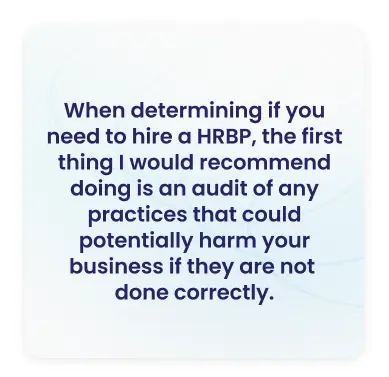
Felicia Cowan, the HR Director of Ballet West, is a friend and dropped my son off literally while I was writing this article. So I asked her for her opinion: “When determining if you need to hire a HRBP, the first thing I would recommend doing is an audit of any practices that could potentially harm your business if they are not done correctly. Areas I would focus on would be hiring, onboarding, employee classifications, personnel files, performance management, employee discipline, employee termination, work environment, and health and safety policies.” It’s nice to have smart friends like Felicia!
Human Resources professionals within a small organization may be seen as a “mile wide and an inch deep.” Don’t worry, small business HR friends, that’s not meant to be offensive. It just means that they’re responsible for anything and everything associated with people. They likely help with hiring, onboarding, discipline or performance issues. On top of that they probably help with managing the front desk, the work parties, and some of the softer elements associated with the office. Essentially, at a small organization, you can expect to be an HR Team of One.
In a larger firm, you’ll experience much deeper specialization. You will have a specific HRBP that focuses on recruiting and maybe even one per department. There will be a group dedicated to learning and development. Someone will focus on culture. In a large firm, anyone associated with HR is going to be in the “inch wide, mile deep” category.
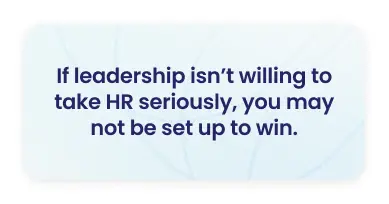
In a small company you don’t need to worry too much about organizational structure, though the most important part may be who HR reports to. If the role doesn’t report into a senior leader or on (or tied closely to) the Executive Team, then that may be a red flag. If leadership isn’t willing to take HR seriously, you may not be set up to win.
,If you feel good about the reporting structure up though, you may consider the following as you grow: hire a generalist and a recruiter. The generalist can help take on the workload associated with payroll, orientation, trainings, etc. The recruiter can cover hiring coordination, ATS management, and all recruiting tasks. Though there’s still room to grow and expand, these hires help cover the fundamentals and give you, as the HR leader, bandwidth to focus on HR strategy and being a strategic partner within the organization.
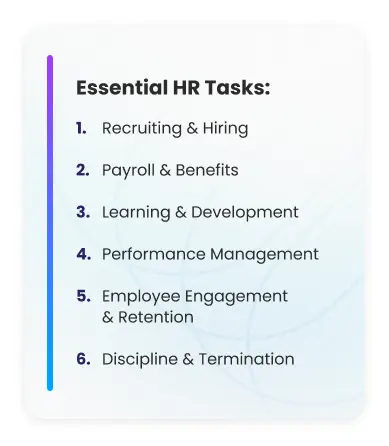
Though we’ve talked about some of the basic roles an HR team would have in a small organization, let’s cover some of the most important tasks. What are the essential HR tasks?
The reality is, it’s not illegal to go without an HR team, but that doesn’t mean it’s smart. Sure, you have the options of hiring a team or having the leadership manage the responsibilities. Companies have an additional option - outsource the HR responsibilities to a third party. Though not the world’s most exciting definition, SHRM says: “HR outsourcing is a contractual agreement between an employer and an external third-party provider whereby the employer transfers the management of, and responsibility for, certain HR functions to the external provider.” Basically, it means you hire someone who doesn’t work for you to support your HR needs.
Inc. highlights a handful of orgs that cover HR outsourcing such as: Oasis (a Paychex® Company), Insperity, and TriNet. Though those are larger and nationally recognized brands, there are certainly smaller firms in your local market. These companies take on the HR responsibilities so that founders can focus on their core business.
One way to empower a team that’s managing all the human resources responsibilities is to empower them with amazing tools. Here are a few examples:
There are a lot of moving parts when it comes to Huma Resources, and we know it can get overwhelming. Bringing on a team member that knows the ins and outs of HR and how to make the most of your work,force can be one of the most powerful things you can do to transform your workplace and bring your team to the next level. Whether you’re ready to bring on an HR team of one or a few, we hope you feel more prepared, comfortable, and in the know to make the best decision for your company!