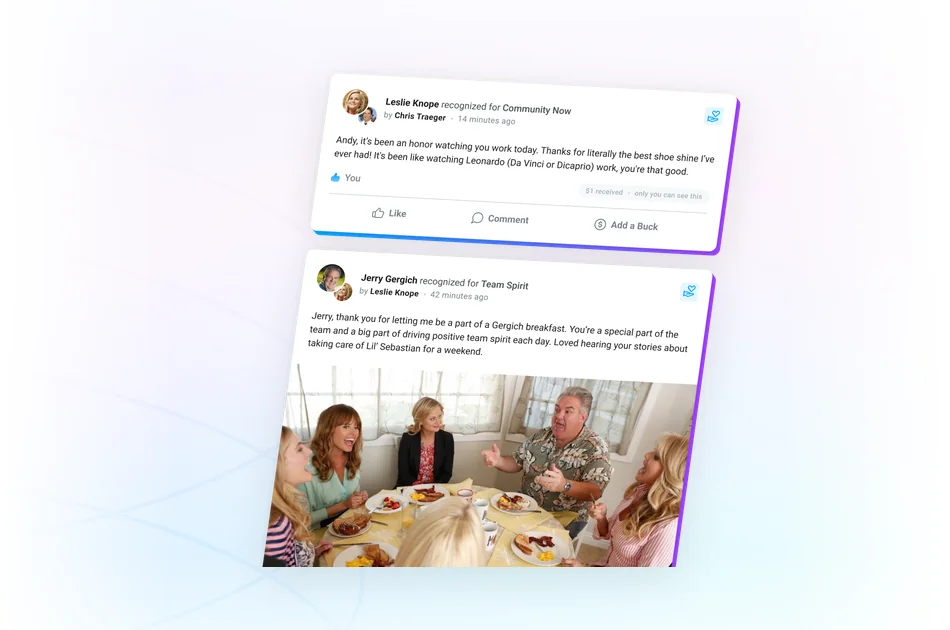

Employee recognition is no longer a “nice-to-have” culture initiative—it’s a proven business lever. Organizations that prioritize consistent, visible recognition see stronger engagement, higher productivity, and materially lower turnover. In today’s distributed, high-pressure work environment, recognition is one of the fastest and most scalable ways leaders can reinforce values, align teams, and drive performance without adding operational complexity.
The most effective recognition strategies go beyond sporadic praise or one-off rewards. They combine peer-to-peer appreciation, leadership involvement, and meaningful rewards into a system that makes recognition part of how work gets done. When recognition is intentional, measurable, and supported by modern software, it becomes a competitive advantage—not just an HR program.
Key Takeaways:
Employee recognition is the intentional act of acknowledging positive contributions, behaviors, and outcomes at work. Recognition can take many forms—written or verbal praise, public shoutouts, peer-to-peer appreciation, milestone celebrations, or tangible rewards like dollars, points, or gifts.
At its core, employee recognition reinforces what matters most to the organization. It highlights behaviors that align with company values, motivates repeat performance, and helps employees feel seen and connected to their work and each other.
Recognition doesn’t have to be complex. It can be as simple as a thank-you message or as comprehensive as a fully integrated recognition and rewards program. What matters most is consistency, visibility, and authenticity.
Today’s workforce is more distributed, more pressured, and more disconnected than ever before. When employees don’t feel acknowledged, the impact is immediate and measurable: lower engagement, reduced motivation, increased burnout, and higher turnover.
Recognition addresses these challenges directly.
Organizations that prioritize recognition consistently outperform those that don’t. Employees who receive regular recognition report higher job satisfaction, stronger engagement, and greater loyalty. In fact, recognition is repeatedly ranked as one of the top drivers of employee engagement—often outweighing compensation alone.
Recognition also drives productivity. Employees are significantly more likely to repeat positive behaviors when their efforts are acknowledged, and the majority say they would perform better if they simply felt more appreciated at work.
Culture isn’t built through mission statements—it’s built through daily behaviors. Recognition is one of the most effective ways to reinforce those behaviors at scale.
When employees see recognition happening across the organization, it:
Recognition transforms culture from an abstract idea into a lived experience.
Recognition fuels positivity. Employees who feel valued are more energized, more satisfied with their work, and more invested in the organization’s success.
Feeling appreciated is one of the strongest predictors of employee loyalty. Recognition reduces regrettable turnover and helps organizations retain top talent—especially during periods of change or uncertainty.
Recognition motivates employees to go above and beyond. When great work is noticed and reinforced, performance improves across teams.
Organizations known for strong recognition cultures attract better candidates, improve referral rates, and reduce recruitment costs over time.
Public recognition reinforces shared values and sets clear examples for others to follow. Common use cases include:
Public recognition is especially powerful for reinforcing behaviors the organization wants to see repeated.
Private recognition is often more personal and impactful for individual development. It works well in:
Private recognition helps employees feel genuinely seen and supported.
Peer-to-peer recognition ensures no great work goes unnoticed. It empowers employees at every level to recognize contributions as they happen—especially work leaders may never see.
This approach builds trust, connection, and shared ownership of culture.
While recognition can stand on its own, pairing it with meaningful rewards increases its impact and longevity. Effective rewards don’t have to be expensive—they just need to be flexible and personal.
Common reward options include:
The key is choice. Employees value rewards they can use in ways that matter to them.
A strong recognition program doesn’t need to be overwhelming. The most successful programs follow a few clear steps:
Determine what the organization wants to achieve—improved engagement, higher retention, stronger culture, or all of the above. Executive alignment is critical here.
Tie recognition efforts to measurable outcomes like engagement scores, retention rates, participation levels, or eNPS trends.
Recognition budgets vary, but many organizations allocate a small percentage of revenue. Segment spending across rewards, technology, and experiential elements.
Recognition works best when leaders model the behavior and employees are empowered to participate. Broad involvement drives adoption and credibility.
Treat the rollout like a business initiative—not a side project. Communicate the “why,” showcase examples, and celebrate early wins.
Manual recognition efforts rarely scale. Modern employee recognition platforms make it easy to operationalize recognition across the organization—without adding administrative burden.
Motivosity helps organizations:
Motivosity customers report employees feel 2x more connected to their culture and are 2.3x more likely to stay, even when offered higher pay elsewhere.
Recognition isn’t about swag or surface-level appreciation. It’s about reinforcing behaviors, strengthening connection, and driving performance in a way that scales with your organization.
When recognition is intentional, consistent, and embedded into daily work, it becomes one of the most powerful tools leaders have to build resilient, high-performing cultures.