
Employee recognition works—but only when it’s done the right way. While traditional, top-down recognition programs (manager-only awards, points systems, gift cards, annual MVPs) were built with good intent, they no longer meet the needs of today’s workforce. They’re inconsistent, exclusionary, administratively heavy, and disconnected from how work actually gets done—especially in distributed, fast-moving organizations. The result? Too many employees feel unseen, too much great work goes unrecognized, and HR, managers, and finance carry unnecessary operational burden.
The modern approach shifts recognition from a leader-controlled activity to a connected, peer-driven system rooted in visibility, frequency, and choice. Peer-to-peer recognition, supported by a digital platform, ensures recognition happens where work happens—every day, across teams, and across locations. When recognition is public, frequent, automated for milestones, and paired with flexible, real-dollar rewards, companies unlock higher engagement, stronger connection, lower turnover, and a true culture of gratitude. Recognition stops being about perks and starts becoming a strategic driver of retention, performance, and employee well-being.
Key takeaways
Motivosity helps organizations modernize recognition by making appreciation visible, connected, and easy—so gratitude becomes a daily habit, not a quarterly initiative.
Employee recognition programs have been around for a long time. And for good reason! For decades, companies have found value from recognizing and rewarding the type of effort, commitment , and performance they want to see from their employees. In fact, employee recognition programs have so much impact that 90% of HR leaders and employees say that these programs directly drive business results. Harvard Business Review agrees, reporting that companies with formal employee appreciation programs outperform companies without a recognition program by a significant margin.
But the impact doesn’t stop there. Employee recognition programs help increase employee happiness and job satisfaction while significantly reducing employee turnover. When companies make employee recognition a high priority, employees have a better sense of well-being and they’re less likely to experience anxiety and stress in the workplace. Plus, recognition and feedback are the top two drivers of employee engagement, helping companies that prioritize recognition programs have a higher chance of having a highly engaged workforce. Recognition programs also help companies hang on to good employees longer with a 31% lower turnover rate.
By prioritizing recognition, companies see another incredible byproduct: a culture of gratitude that encourages employees and leaders to show up for their teammates, the business, and themselves.
The bottom line: Modern recognition programs drive better results because they’re rooted in principles of positive psychology, reinforcement, and personal connection.
Most companies have something implemented for recognition at their workplace. At the most basic level, it could be a quarterly MVP award, a celebration of tenure, or awards related to company values. Other companies might have a more intricate program involving physical notes, “bucks,” or points that employees can redeem for prizes, gift cards, etc. In all of these cases, the recognition programs follow a top-down approach.
But these methods are outdated. They aren’t focused on employees so they don’t work.
While top-down recognition, like manager-only points systems or quarterly MVP awards, are important and can help employees get recognition from leaders in the org, they miss out on a few key things:
Top-down recognition programs often leave few people feeling valued and most of the workforce feeling left out and unseen. For employees, getting recognized with these programs is more often than not based on your manager or the type of work you do (e.g. working in sales might offer more awards to keep the sales team motivated).
With a manager-only points system or another top-down approach, good deeds and good work are likely to go unnoticed. Managers and leaders simply can’t see everything their employees do, so opportunities for praise are often missed.
Managers, HR, and even finance are required to spend a lot of manual, time-consuming effort on top-down recognition programs. Buying and handing out gift cards, making sure monetary gifts are taxed appropriately, and getting certificates together are just the start.
When employees receive manager points they cash in for prizes or money, tracking the financial side of the top-down program is challenging. If everyone decided to cash in on their rewards in a single day (or even week) what would that look like for the business? How much would the business be spending on rewards if everyone decided to turn in their points for money?
Buying gift cards is a popular way to recognize employees for their good work, but the backend effort isn’t simple. The fees cut into the overall recognition budget and employees don’t always use the gift cards they’re given, banishing the gift card to someone’s desk drawer unused.
For many companies, employees are only allowed to pick a reward/prize from a select number of items. Whether it’s a specific milestone gift (e.g. a company branded watch), swag item, or a gift card to a pre-named place, it may not always be what the employee really wants. Plus, adding the reward amount to the employee paycheck often results in the employee using it for family expenses, not as a reward just for them.
The dreaded “Happy Birthday!” and “Congratulations” email chains seem to snowball into more and more reply all responses, leaving most respondents annoyed and the recipient filled with thoughts that everyone felt obligated to say happy birthday or congrats because it was such a public format.
These top-down, manager-led recognition programs are clearly filled with so many challenges and fall short of helping every employee get recognized for the work that’s worth recognizing. And there’s a lot of that work!
Employees want to be recognized for a job well done or any big accomplishment they have at work (e.g. a big project they just finished, a new platform that was onboarded, a new client they just landed, etc.).
Employees want recognition when they show excellent customer service to the company’s customers, helping the company with customer retention and up-sells.
A company’s mission and values are critical to building culture and helping employees know how to show up to work. When employees exemplify those values, it’s imperative that the company recognize the effort and reward the employee.
Reaching key milestones
When employees reach significant milestones—birthdays, work anniversaries, and retirements—it’s nice for their manager and company to acknowledge the event and the celebration.
Advancements and promotions are critical times for employee recognition. Public communication about a new role shows the employee that the leadership team approves of this change and supports the employee.
Internal contests, employee trainings, and other internal employee initiatives are an important part of work. These accomplishments shouldn’t go unnoticed, they’re ripe for recognition.
With so many good things to celebrate and recognize, how do you make sure every employee gets recognition and thanks consistently for everything you want them to be recognized for?
Your people are your greatest asset. This fact alone typically drives an initial push for a recognition program at most businesses. Keeping your greatest assets happy is important for employee well-being, retention, and productivity. The more you recognize employees for the good work they do, the more good work they want to do. This cycle continues as employees who are recognized feel higher motivation, more engagement, perform better, and even give better customer service.
But more than recognizing employees to keep them happy, good leaders know that when you have great employees, you want to retain those employees. Turnover is expensive, disruptive, and slows down innovation and productivity at every business. Higher turnover rates can also negatively impact your reputation and ability to hire great talent in the future. Good recognition programs help everyone—keeping employees happy and helping companies retain happy employees.
Employee happiness and retention and the ultimate goals. Using these two metrics, it’s easy to measure the effectiveness of your recognition efforts. (Think eNPS results and turnover rates to see how impactful your current recognition program is / to see how much room for growth your recognition program likely has today.)
We all recognize recognition is important. But recognition can’t just be about perks or stuff. These things are nice, but they don’t make people want to stay at your company or stay in their jobs. Employees leave when they don’t feel connected—to the business, to their team, to their managers—and when they don’t feel valued or seen.
Recognition works best when a connected culture is the foundation. Most companies in today’s work environment—a mix of remote and in-office employees—struggle to unite a disconnected workforce. Multiple locations, teams spread across time zones, different working hours, and more. The times have shifted and you can no longer rely on physical proximity to bring people together and unite them. Now, the next best option is digital proximity.
How do you connect people digitally? Foster connection and community by bringing people together where they can interact and connect on common interests. Many companies create spaces like this for project work and collaboration—Slack, Teams, etc. But to build a connected culture, your employees need a space that’s separate from conversations about work. You need a space for the people, a modern water cooler where employees can connect on the things they like to do, what they like to watch, things they’re interested in, and more.
Until you tackle the disconnection problem in your workforce, recognition programs will continue to be about perks and products, things that don’t connect employees to their jobs or the people at work. In a modern approach, companies give their employees more reasons to stay at their job with a connected culture (and more meaningful recognition with better recognition programs).
To break away from inconsistent, impersonal, and top-down methods of recognition, HR leaders and businesses have to think outside the traditional approach. It will never be possible for every manager, leader, or executive to recognize every job well done, every accomplishment, every show of customer service, every milestone, every situation where employees exemplify company values, and so on.
Ditch the top-down programs and trade them in for a more meaningful approach to recognition—peer-to-peer recognition.
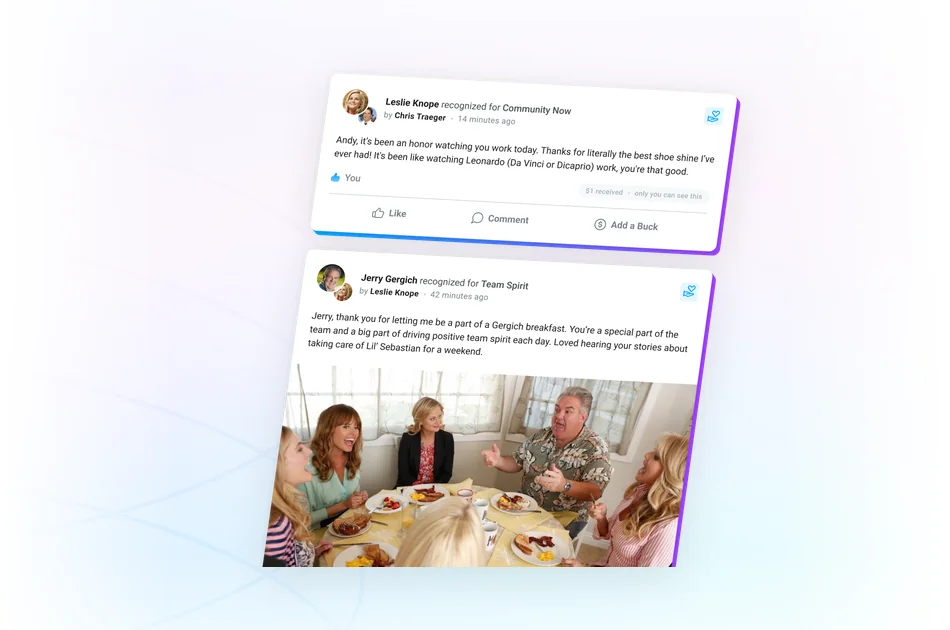
With peer-to-peer recognition, you can “hire” every employee to recognize the good stuff happening across the organization all the time.
→ Peer feedback can enhance employee performance by as much as 14%.
But don’t put a cap on how often peers should recognize each other. Encourage frequent recognition. When employees only receive recognition from their peers a few times a year they are 3x as likely to be disengaged, 39% more likely to say they plan on finding a new job in the next year, and 24% more likely to be struggling.
Encouraging peer-to-peer feedback frequently is the key to helping everyone feel recognized, supported, and seen.
Don’t let good deeds go unseen. Make every recognition public so everyone has a chance to see the good across the business. By highlighting the good work employees are engaged in every day, employees have an opportunity to connect to each other and be motivated by other employees’ efforts.
Public recognition socializes the good and reinforces a positive, connected culture, helping everything feel valued. With a digital platform, dedicated to recognition and connecting employees (away from work conversations), everyone can see and engage with peer-to-peer recognition.
And of course, for the times when a recognition should stay private (maybe , you can do that too.
Save time and make sure no one gets missed by automating the recognition that you know runs on a specific timeline. Milestone awards—birthdays, work anniversaries, retirements, etc.—shouldn’t create more work and they shouldn’t ever be missed. With a digital platform dedicated to recognition, milestone awards/gifts should be automated.
By automating milestone recognition moments, HR leaders and managers don’t need calendar notifications or heads-up emails to make sure their employees are recognized on the right day. In a modern approach, the digital platform manages these dates and automatically recognizes each employee on their special day.
It’s clear that points don’t work for employees or for managers/HR. Turning in points for a prize you don’t want isn’t fun and worrying that every employee will turn in points for their cash value at the same time is a stress finance doesn’t need. Instead, ditch the points and give real dollars!
Employees are just like their managers—they want money to spend on the things they want, too. By moving your recognition program to a dollar-focused program, everyone gets what they want. No more company-branded watches (you can get those at the next all hands meeting), catalogs, or pre-approved gifts. Cash means everyone picks what they want and they can spend it on themselves.
With a dollar-focused rewards program, employees can use those dollars to buy things they really want. And you can still offer other items as options (with option as the key word—prioritizing choice for every employee). Offer gift cards, charitable donations, swag, and cash to ensure each employee gets what makes them feel appreciated, seen, and rewarded.
By modernizing your recognition program, you’re showing your employees that you really care about their recognition experience. Plus, you’re ensuring that your recognition efforts don’t go to waste.
A modern approach to recognition helps you:
By automating milestone recognition and reducing spend on hefty gift card fees and prizes employees aren’t excited about, a modern recognition program helps you streamline recognition and reduce your reward spend.
Gather more robust employee insights with a platform that gathers eNPS results regularly. With a dedicated peer-to-peer recognition solution, you can conduct employee surveys more frequently and see patterns in the commentary and recognition employees send to their peers.
Don’t wait for a culture of gratitude to show up. Help your employees build it by offering a better way to be recognized and to recognize others. This cycle of recognition builds connection between employees, leaders, and managers, helping everyone grow closer.
Peer-to-peer recognition opens up more opportunities for employees to be recognized frequently. No more pressure for managers and HR and more recognition for everyone.
Building a better recognition program means building better reasons for your people to stay long term. With more connection, a culture of gratitude, more frequent recognition, and rewards that employees want, turnover takes a nosedive and retention soars.
Bring your recognition program into the 21st century with Motivosity, the employee experience platform that helps you create and foster connected, winning cultures. With Motivosity, you can make your employees’ experience at work more meaningful, get real-time insights into employee engagement, help managers create the right habits focused on employees, and build a community of connection and gratitude with peer-to-peer recognition.
Find out more about Motivosity here.