
Employee recognition is not a feel-good perk—it’s a proven business lever with measurable impact on engagement, retention, productivity, and profitability. Organizations that consistently recognize employees see lower turnover, fewer sick days, higher performance, and stronger customer outcomes. Yet many leaders still view recognition as optional because they lack a clear business case, budget clarity, or ROI framework. When recognition is tied directly to company KPIs—engagement, productivity, retention, and growth—it becomes one of the highest-ROI investments a business can make.
The data is unequivocal: recognition drives engagement, engagement drives performance, and performance drives profit. Even modest investments (as little as $5–$20 per employee per month) can unlock millions in savings by reducing turnover, absenteeism, and disengagement. The most successful organizations gain leadership buy-in by framing recognition as a solution to existing inefficiencies, leveraging peer-to-peer recognition at scale, and using technology to automate, measure, and amplify impact—especially in remote and hybrid environments.
Key takeaways
When recognition is treated as a core business strategy—not an HR add-on—it becomes one of the most powerful tools leaders have to drive performance, loyalty, and long-term growth.
Employees are the backbone of any organization, and recognizing their contributions builds a more motivated, engaged, and high-performing workforce. The proof is in the numbers: recognition leads to employees who are more satisfied with their jobs, it’s one of the top drivers of employee engagement, and more than 90% of employees are more likely to repeat specific actions when they are recognized for their effort.
A strong recognition and rewards program doesn’t stop there. It boosts morale, enhances productivity, and creates a culture of appreciation, encouraging employees to show up for their team, the business, and their role in the company.
When employees feel heard and understood, they’re 4.6x more likely to perform their best work.
With all of these benefits, it’s hard to see why so many organizations overlook the strategic value of recognition, treating it as a bonus or an extra perk, rather than a true business initiative. Too many leadership teams often question whether investing in employee recognition truly impacts business outcomes.
Here’s the real truth: when employees are happier and more productive at work, they stay longer, work harder, and bring the business more profits. One of the ways this shows up is in reduced turnover (by 50%) and reduced sick days (by 75%). And when employees are more engaged (which recognition is proven to improve), profits increase by at least 21%.
The purpose of creating this business case is to offer concrete data, financial justifications, and cost-effective strategies to demonstrate why recognition should be a priority for every organization. With this information, you can align recognition programs with business objectives, garnering leadership support and ensuring a sustainable, high-ROI initiative.
Despite how critical recognition programs are to employee engagement, retention, and productivity, too many businesses fail to see their importance. While 70% of employees believe their employers care about recognition programs, only 34% of employees say their company has a recognition program, highlighting a serious disconnect.
Employee engagement has unmistakably fallen to a 10-year low. A key factor? Employees feel less connected to their employers—they don’t have a clear view or understanding of their work’s mission and overall purpose. This critical misstep highlights a serious culture impact (and a very obvious area that could use room for improvement).
A great way to improve company culture and connect employees to your mission and vision? Connect your recognition program to your company. Encourage leaders and peers to highlight and recognize employees that emulate your company values. You’ll see a greater connection between your workforce and your company’s overall vision.
Low engagement is a clear indicator of a few things, namely low happiness, low motivation, and most importantly, little connection to the work your employees are doing. The solution? You guessed it—recognition.
At least 40% of employees say that recognition is a sure fire way to help them improve their engagement (and doing so will help them feel more satisfied with their jobs). And for 80% of employees, recognition translates directly into higher performance, helping employees feel motivated to work harder.
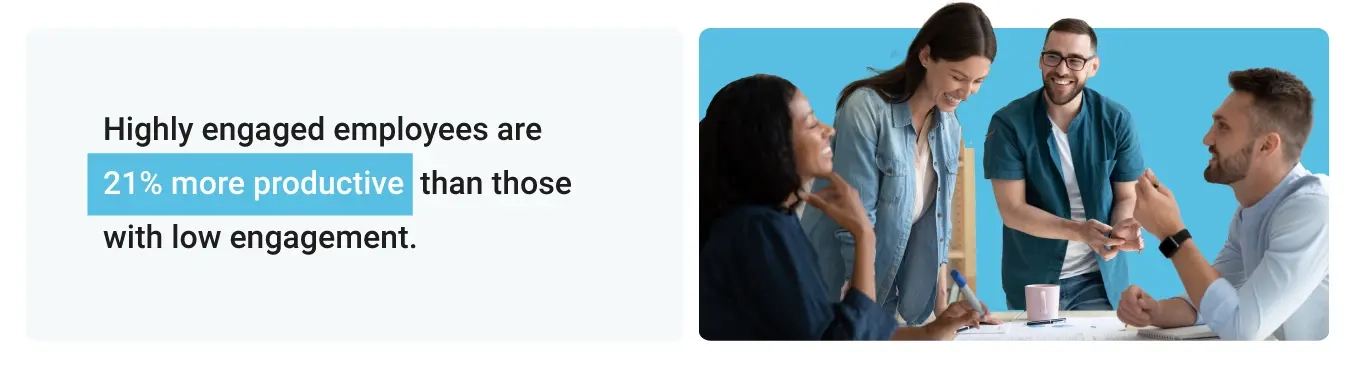
Highly engaged employees are 21% more productive than those with low engagement.
On the flip side, employees say one of the top reasons they lack motivation to be productive is a lack of recognition. And it’s easy to see why. The psychology of recognition applies to all areas of our lives—including work (where we spend most of our time).
Quick fact: Organizations with recognition programs report 14% higher employee engagement, productivity, and performance vs. organizations without a recognition program.
Employee retention is good business and the best employers recognize that it’s not just productive to keep good employees, it’s cost effective. Turnover issues are expensive and disrupt the performance of everyone connected to the employee who leaves. Plus, while the cost to replace employees varies by industry, it’s not uncommon to see totals ranging from 1.5 - 2x the employee’s salary.
High employee turnover also impacts your reputation to hire top talent in the future. It’s critical to consider the future losses your business might face if you struggle with retention issues that could easily be fixed with recognition.
With astronomical replacement costs and abundant morale issues, retention is a serious business challenge that requires attention. And attention is exactly the antidote. Just as recognition directly impacts employee engagement and productivity, it’s no surprise that the next direct result is in employee retention.
Today’s employees expect a workplace culture that values their contributions. And the numbers back it up—when employees receive recognition, they’re 45% less likely to leave their job. Not many retention strategies bring those kinds of guarantees. Recognition offers an easy win.
More than 90% of HR professionals report that employee recognition programs positively impact employee retention.
It’s clear that employee recognition impacts employee performance, which in turn, directly influences an organization’s bottom line. This shows up in a few ways. First, when employees feel appreciated, they don’t call in sick as often (reducing sick days by 75% And those sick days add up. Data shows that in the U.S., sick days can cost an employer $2,945 per employee every year. Larger companies have an easier time absorbing these costs while smaller businesses severely feel the pain when key team members aren’t at work.
When employees are more engaged—more connected to the business, appreciated for their efforts, and happy to be at work—overall profits increase by at least 21%.
But the connection to profits doesn’t stop there. Employees who feel valued help the business grow because they show up to work happier, do their jobs faster, and treat customers better. Gallup found that when employee engagement is up, customer loyalty increases by 10% sales productivity improve by 18%, overall productivity climbs by 14%, and profitability can see growth beyond that 21 to at least 23%.
Scenario 1: 150-person company
Let’s look at an example scenario to review the financial benefits of investing in a recognition program:
In this scenario, a 150-person company with an average salary of $50,000/year and a turnover rate of 13.5% is earning $25M per year with a $200,000 average revenue contribution.
We’ll consider the cost of disengagement to be 14% of each employee’s annual salary, the cost of turnover to be 33% of each employee’s annual salary, and the cost of absenteeism to be $2,945 per employee based on the latest data. With these numbers, we can see that the total cost to the business without a recognition program totals more than $1 million.
Now let’s review the potential for savings. We’ll use the data presented in this business case to assume a 21% increase in engagement (and productivity) (and productivity), a 50% improvement in turnover, and a 75% improvement in absenteeism. With these rates, we see a significant opportunity for cost savings totalling nearly $1 million. And with the addition of the lost costs, a recognition program could prove to be worth more than $2 million in this scenario.
The recommended investment for an employee recognition program sits between 1-2% of total payroll costs. SHRM has recommended this number for nearly a decade with several reports showing that companies who invest this amount see the biggest return on their investment—increasing employee engagement, productivity, motivation, and more.For businesses new to recognition programs with a tighter budget, the recommended investment can look like $5 - $20 per employee per month, or $60 - $240 per employee per year.
Scenario 2: 5,000-person company
In this scenario, let’s look at a 5,000-person company with an average salary of $50,000/year and a turnover rate of 13.5%, earning $500M per year with a $150,000 average revenue contribution.
We’ll consider the cost of disengagement to be 14% of each employee’s annual salary, the cost of turnover to be 33% of each employee’s annual salary, and the cost of absenteeism to be $2,945 per employee based on the latest data. With these numbers, we can see that the total cost to the business without a recognition program totals more than $46 million.
Now let’s review the potential for savings. We’ll use the data presented in this business case to assume a 21% increase in engagement (and productivity), a 50% improvement in turnover, and a 75% improvement in absenteeism. With these rates, we see a significant opportunity for cost savings totalling nearly $24 million. And with the addition of the lost costs, a recognition program could prove to be worth more than $70 million in this scenario.
Employee turnover costs might seem like a cut and dry number—recruiting a new employee and offering them a compensation package—but the reality is much more staggering. SHRM reports that departure costs average around one-third of the employee’s annual salary. That’s an astronomical price when you consider the budget required to replace a specialized role.
For example, replacing a top sales rep, a VP of Product Management, or even a highly-skilled developer earning a salary of $250,000 would result in an average of $82,500 to find a replacement.
And when you break down that total turnover cost (one-third of the total annual salary), you find why that number quickly adds up:
→ 67% of turnover costs are attributed to soft costs that include lost productivity, interview time with potential new hires, and lost knowledge that walks out the door with your former employee.
→ 33% of turnover costs are attributed to hard costs that include recruiting efforts, background checks, drug screens, and even temp workers to help fill the gap while you search for a new employee.
The bottom line: losing an employee goes beyond just recruitment. Turnover costs stack up when you consider the impact to the team’s productivity, training needed for a new hire, potential disengagement for remaining employees, lost knowledge, and more.
Investing in a well-structured recognition program can help businesses mitigate turnover-related expenses while improving overall retention.
68% of HR professionals say that employee recognition significantly improves retention (and 56% say it helps with recruitment).
When employees feel like they belong at work, companies see an 84% increase in employees’ intent to stay vs. find a new job.
For many organizations, the hurdle of leadership buy-in can feel too big to manage. But the reality is simple—executives are more likely to support initiatives that align with key business objectives. They want to invest in programs that will help them do their jobs better and help the company succeed.
When you tie employee recognition to the initiatives and company KPIs that the c-suite cares about (and is actively pursuing with other initiatives and budget), the case for recognition becomes easier to present.
Before you present your case for a recognition program to an entire room of executives, it’s critical (and very helpful) to have an executive who sponsors the effort. The best strategy here is to solicit help from your CHRO or VP of People Ops. Present your evidence to them about how a recognition program aligns with the company’s initiatives and ask for their support. Once you have the buy-in from one executive, they can go to another leader and ask them to sponsor the idea as a team.
Once you have a clear connection between recognition and company objectives, and you’ve gathered two executive sponsors, it’s time to put together your presentation. Gather all of the documentation and evidence you need to create a compelling deck.
Make sure your presentation answers these questions:
The goal of your presentation should be to highlight the inefficiencies in what the company is already doing and how a new tool can help you automate and consolidate processes—making it faster and easier for everyone. For example, if your company is already gifting birthday and anniversary celebrations, you’re likely doing it manually (consider how much time you’re spending) and inconsistently (consider how many people you may miss based on the manual efforts). Your company might already be spending budget on MVP or Core Value Awards and gift cards for spot recognition. Calculate the time and cost of these programs and the potential issues with each. Your presentation should make it clear how much is spent right now (in effort, time, and budget) and how much could be saved—and gained—by adding a recognition tool (in effort, time, budget, retention, productivity, engagement, etc.).
Use general and industry-specific data.
Use the data outlined in this business case to show how recognition directly contributes to employee engagement, customer satisfaction, and the bottom line. Industry benchmarks can offer a great argument, especially when you consider specific turnover rates and productivity rates that vary based on work type and vertical.
Present case studies of recognition program success stories.
Use the stories of other companies who have implemented recognition programs and have seen success. Many recognition solutions showcase these case studies and make them available for everyone to read and download.
See a collection of Motivosity case studies here.
Highlight employee engagement metrics.
Use your own employee data to illustrate the need for a recognition program. Get clear on your company’s turnover rates, average time to hire, average time to productivity, average sick day/absenteeism rates, and your most recent employee satisfaction and engagement survey information. All of these key findings can help you present data-driven evidence that your business needs a recognition program.
Focus on the competitive advantage.
Companies with strong recognition programs see benefits in both attracting top talent and retaining top talent. Highlight this in your strategy to gather leadership buy-in as a strong competitive advantage (especially when others in the market are competing for the same candidates).
One key data point to consider: only 30% of employees feel connected to their company’s mission, resulting in decreased loyalty and increased turnover. This is a new low for today’s workforce, and companies that employ hybrid or fully-remote workers might see an even lower number. Integrating a recognition program that reinforces your company values can not only improve employee happiness, engagement, productivity, and retention, but it can also be the solution many businesses are looking for to reduce the distance they experience with remote and hybrid workers.
Consider this—in industries with high turnover, such as retail and hospitality, recognition programs help businesses retain skilled workers and provide better customer service. Forbes highlighted this recognition benefit, noting that when employees feel happier and more engaged, they’re more likely to provide better customer service and represent the business in a positive way, which then increases customer satisfaction and even loyalty.
Recognition doesn’t have to be expensive to be effective. In fact, it can be a cost-effective strategy that leads to measurable financial benefits, helping companies hold on to top talent, build a stronger culture, and stay competitive in the market.
If you don’t have the budget to invest in a dedicated Employee Recognition and Rewards tool right now, even small, meaningful gestures can have a big impact. Need a few examples? Check out this list of low-cost initiatives:
Even though recognition in its most basic form can help an organization move the needle on employee engagement, retention, productivity, and profits, the most successful companies recognize the benefits of leveraging a digital solution and the synergy and consistency you can find with the right recognition tool.
The right recognition tool will prioritize these areas to build the right environment for employee recognition:
1. Social connection and communication
Recognition siloed in meetings or thank-you notes alone won’t multiply into more recognition across the org—employees need to see recognition in a public way, improving their connection to each other and the business.
2. Instant, flexible, and global rewards
Verbal and written praise is a great start, but rewards make recognition even better. The right tool will offer an easy-to-use rewards solution that accompanies recognition as it’s delivered, with digital and physical product options and flexibility in the type of rewards your employees can redeem.
3. Scalability
Quick setup and even faster adoption are critical to ensure a recognition program has some legs for the long run. And the best solutions offer an easy way to grow as your employee base grows, automating frequent rewards, building out more programs, etc.
One thing to note: If your business is already using an employee communication tool like Slack or Microsoft Teams, you can find an integration for instant recognition. These integrations make setting up your new recognition program easy for everyone—helping increase adoption across the business.
Leveraging technology to digitize recognition can offer even more benefits:
A digital solution can help ensure you reduce the manual labor often associated with recognition programs (e.g. sending a specific reward for a specific type of recognition, like a new hire’s first day) and make sure you don’t miss a key moment for recognition (e.g. a milestone, a birthday, etc.).
Recognition that isn’t digital can be difficult to track. Without a digital solution, you can’t get a clear idea on how many employees are actually receiving or giving recognition. Robust reporting is critical to track your ROI.
When recognition programs aren’t digital, they often rely on physical rewards, like gift cards or swag. This type of program leans heavily on the work of HR, storing and distributing these gifts. A digital recognition and rewards experience eliminates this manual work and can save both time and money—sending dollars or gift cards in real time and allowing employees to redeem points or dollars for physical gifts that can be shipped directly to them.
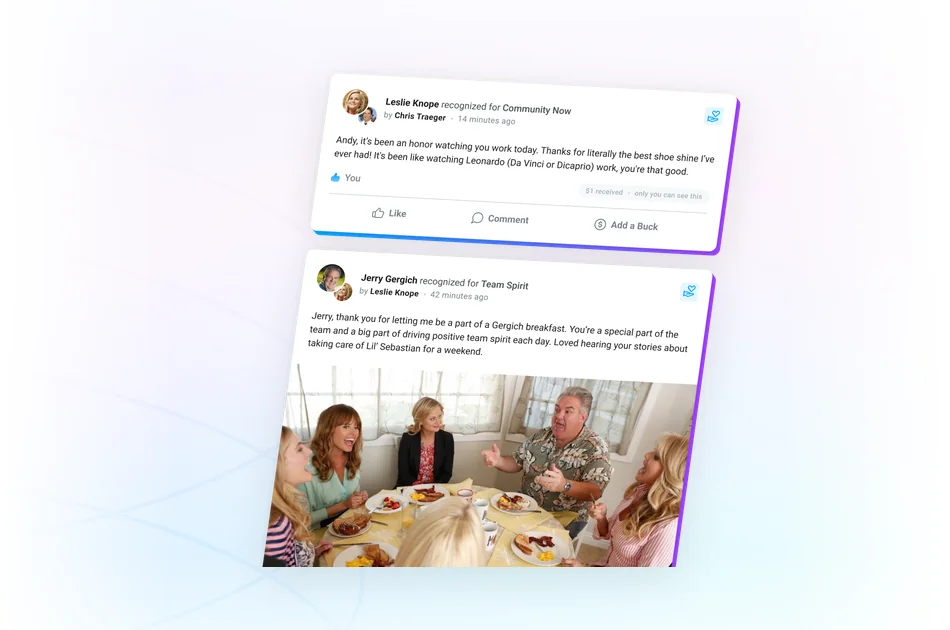
Recognition shouldn’t only come from leaders or managers. When employees appreciate each other, it strengthens the entire workforce, improving teamwork and morale across the organization.
In fact, peer-to-peer recognition can enhance recognition benefits even more. Employee performance can improve by as much as 14% when employees receive specific peer feedback. And when peer recognition is absent, employees report that they are 24% more likely to be struggling and nearly 40% more likely to look for a new job. And the worst metric? Employees without peer recognition are 3x as likely to be disengaged.
What does peer-to-peer recognition look like? It doesn’t have to be complicated.
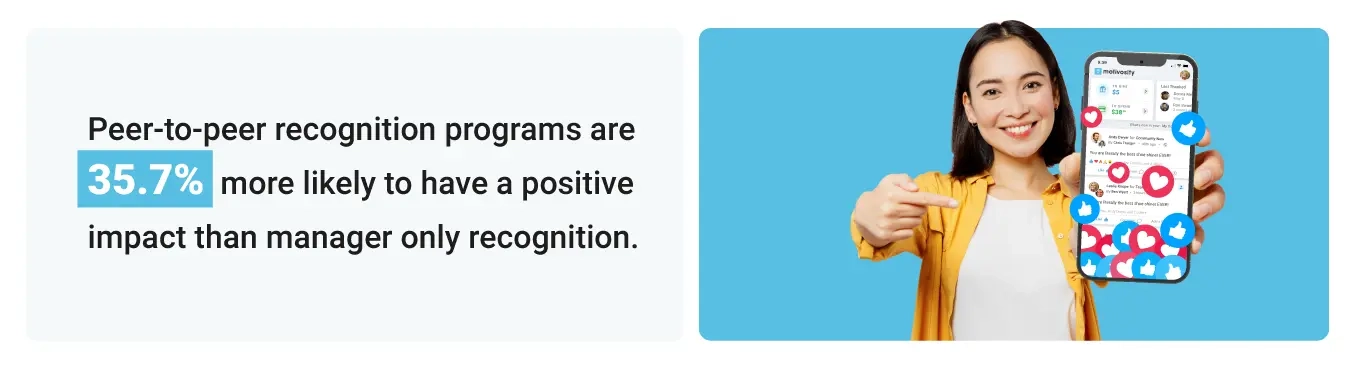
Peer-to-peer recognition programs are 35.7% more likely to have a positive impact than manager only recognition.
Google
At Google, gThanks is their version of peer-to-peer recognition allowing employees to send virtual thank-you notes (and monetary bonuses) to their coworkers. This has helped build a culture of gratitude, reducing turnover and improving employee connection to the business.
Zappos
At Zappos, Zollars are used to reward employees that facilitate a positive customer experience—sent by both peers and leaders. These dollars are redeemable for a variety of rewards, offering Zappos employees true flexibility in how they feel appreciated.
General Motors
At General Motors, peer-to-peer recognition helps them connect their 170,000 global workforce. With their recognition program, they’ve been able to achieve a 97% activation rate (with an 80% target) with 7 out of 10 employees actively using the program every month (sending an average of 1 recognition monthly to each employee).
Deseret First Credit Union
Founded in 1955, Deseret First Credit Union has a long history of employing people who love what they do and who they engage with at work. As the company has grown, they’ve spread out to over 5,000 locations, making it harder to build a cohesive culture for everyone. And while morale and engagement was positive, they knew it could be better—and that they could find a way to better utilize their budget for recognition.
With Motivosity, Deseret First found what they were looking for—a peer-to-peer recognition program that infused employee engagement across the organization. And they quickly saw incredible results:
→ 1,167 appreciations given in just one month
→ 10.08 average appreciations given out by managers each month
→ 2,391 appreciations tied to company values
→ 99% platform engagement
Even their skeptical CEO and AVP of Business Intelligence have seen impactful ROI from their new recognition program:
"I’m a former CFO so I have that doubtful part of me; a skeptic if you will. When Motivosity was first presented to me by our HR team, I said ‘we will give it a shot and see where it is.’ Boy, was I wrong. The biggest impact Motivosity has for DFCU is engaging people on a deeper level, beyond individual teams or branches."
—Shane London, CEO
"We already had a budget set aside for appreciation at our credit union but when we started using Motivosity, I feel like the impact and utilization of the budget became significantly better."
—Taylor Sanderson, AVP of Business Intelligence
Offering 24/7 pediatric telemedicine across the U.S., the Bay Area startup, Blueberry Pediatrics, needed a serious solution to connect their fully remote workforce, help them with engagement in groups and programs, and bring together siloed company communication to employees.
With Motivosity, Blueberry Pediatrics found what they were looking for—an all-in-one recognition and communication platform that helped them increase connection and employee satisfaction. And they saw immediate ROI:
→ 89% increase in program participation from employees
→ 30x increase in employee recognition
→ eNPS baseline of +50
→ 1 channel for all company communications
The Head of People at Blueberry Pediatrics has seen a dramatic increase in connection across the company:
“Before we had Motivosity, [employees] couldn’t tell what was happening in marketing or sales, they were just focused on their own role. Now everyone has access and the ability to recognize anyone across the organization. One employee told me that Motivosity has made it possible for him to see how much good is done across the company.”
—Colton Richins, Head of People
“Before Motivosity it was all work. Post Motivosity, you're finally starting to see people as they are—humans. And I think that it is creating a lot more empathy behind every single one of our team members because you are learning a lot more about these people that you spend every day working with…And that just creates a better experience and it deepens relationships. It helps you work better with one another, which I expect to have more impact on our ability to be successful as a business.”
—Colton Richins, Head of People
While any employee recognition is better than no recognition, companies see the best results when they follow these best practices:
1 - Recognize efforts as soon as possible.
Good work should be recognized on the spot, or as soon as possible, to show employees that leaders value their effort and work.
2 - Recognition should be genuine and specific.
Praise that clearly highlights why the employee is getting recognized is received better (and often results in employees repeating those actions again).
3 - Recognition should be connected to company values.
When employees are recognized for work or efforts that align to the company’s mission or values, they feel more connected to the organization and their team.
4 - Recognition should be consistent.
Whether it’s formal, public, or a more informal type of recognition, employees should see some type of consistent praise for their good work.
5 - Recognition should come from peers and leaders.
Acknowledgment delivered from both managers and coworkers is meaningful, and it signals that good work is valued at all levels.
6 - Rewards should be flexible.
Just as recognition should be a mix of formal and informal strategies, rewards should be just as flexible, allowing both monetary and non-monetary options.
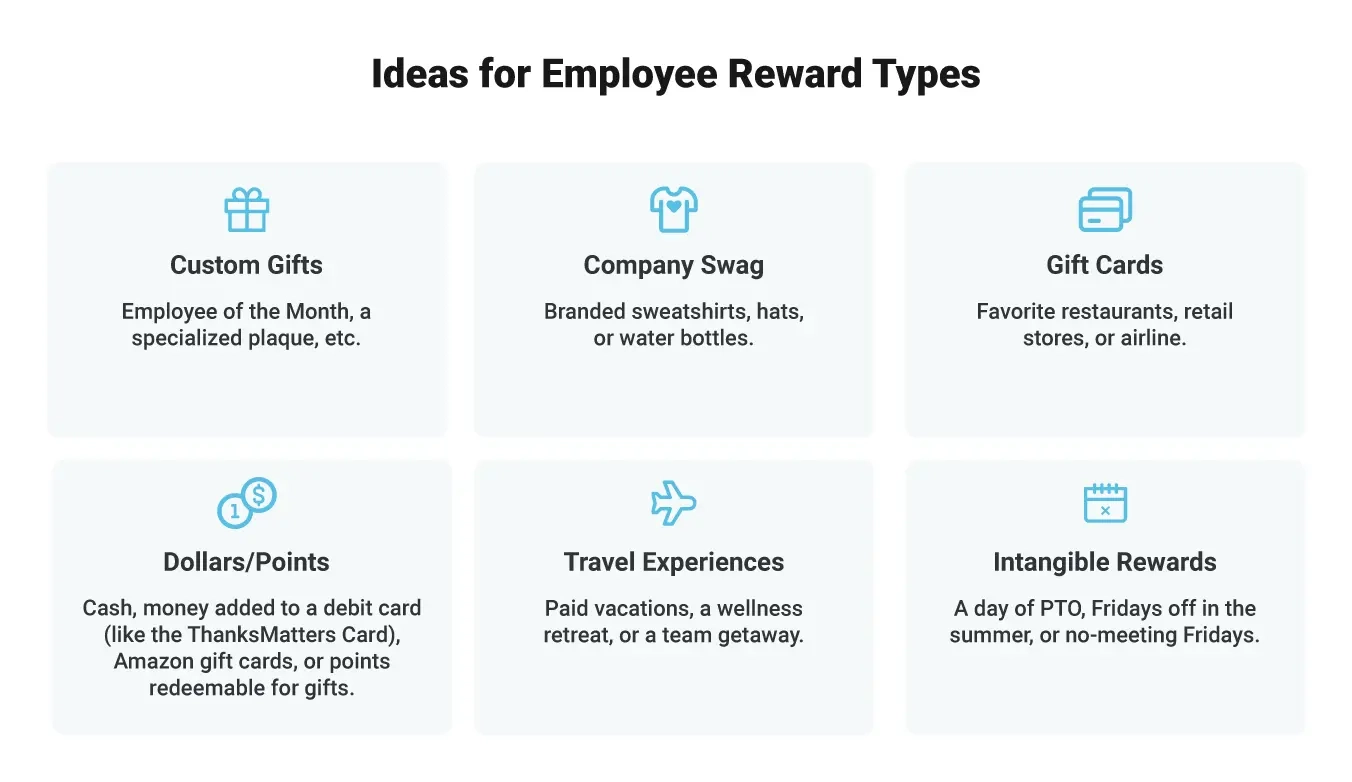
Ideas for employee reward types:
Custom gifts—Employee of the Month, a specialized plaque, etc.Company swag—branded sweatshirts, hats, or water bottlesGift cards—favorite restaurants, retail stores, or airlineDollars/Points—cash, money added to a debit card (like the ThanksMatters Card), Amazon gift cards, or points redeemable for giftsTravel experiences—paid vacations, a wellness retreat, or a team getawayIntangible rewards—a day of PTO, Fridays off in the summer, or no-meeting Fridays
✓ For managers: Make recognition a daily habit. Even small, consistent efforts can lead to long-term cultural change. Proving recognition makes a tangible impact on your team will help prove your case in the long run.
✓ For HR Leaders: Start by gathering employee feedback and piloting a small-scale recognition initiative. Then gather the industry-specific data you need to build a compelling business case.
✓ For Executives: Evaluate the long-term ROI and consider recognition as a strategic business investment.
Employee recognition and rewards aren’t just a nice-to-have benefit that can be easily dismissed. They’re a critical piece of any successful business’s overall strategy. It’s clear that recognition impacts everything from employee satisfaction to sick days to staving off resignation letters. It drives higher engagement, increased productivity, and improved retention, building a conclusive case for its place in the business.
Modernize your recognition program with Motivosity, the people-first Recognition and Rewards solution for today’s workforce that creates more engaged employees, automates your programs, and connects people across teams.
Find out more about Motivosity here.