
Employee morale refers to how employees feel about their jobs, leadership, and work environment—and it directly impacts productivity, engagement, retention, and profitability. High employee morale drives better business performance, while low morale is linked to absenteeism, disengagement, and turnover.
While often confused with employee engagement and motivation, morale is foundational: when employees feel satisfied and valued, engagement and motivation naturally follow. Organizations that prioritize leadership quality, recognition and rewards, communication, work-life balance, career growth, and positive culture are more likely to build high-morale workplaces. Measuring morale through surveys, performance metrics, turnover data, and employee feedback is essential for sustained organizational success.
First, a quick definition, as terms like this are sometimes misunderstood or misconstrued.
Morale refers to the outlook, mood, and enthusiasm of either an individual or a group of people. So, when we take that into the workplace, we get the term "employee morale," referring specifically to how employees feel about their jobs, their employers, and their working environment, on the whole.
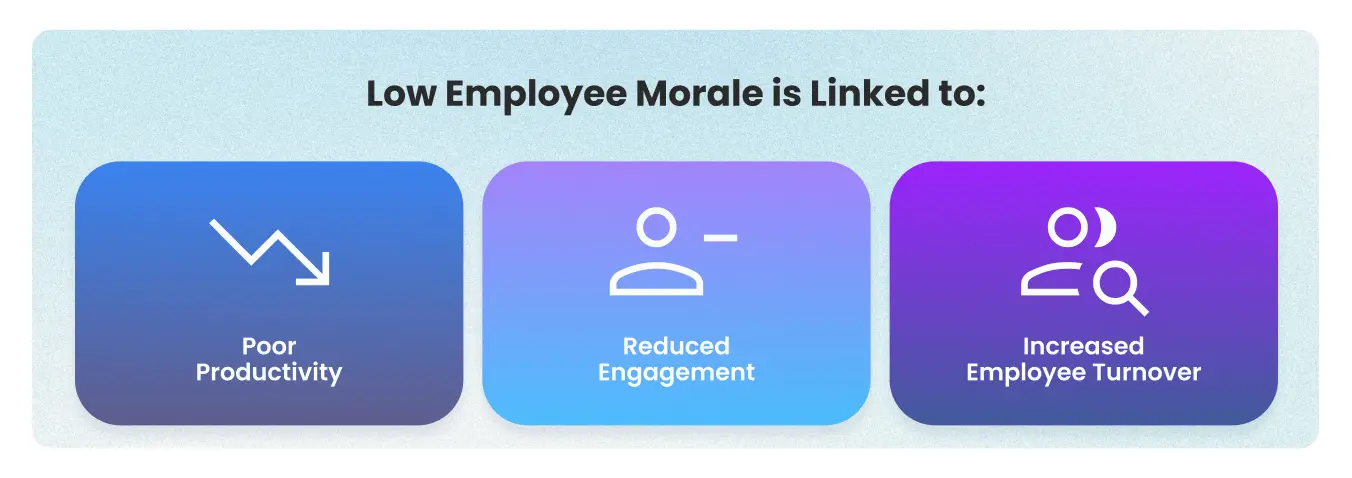
Is employee morale important? Without a doubt. Reports consistently show that low employee morale is linked to a range of issues, such as poor productivity levels, reduced engagement, and increased employee turnover. Conversely, businesses with high employee morale tend to be more productive, profitable, and successful, with an engaged and committed workforce.
This is why so many leading brands place significant emphasis on workplace morale. They recognize its critical value, understand the risks associated with low morale, and use every tool at their disposal to track and improve employee morale in ways that are both meaningful and cost-effective.
Terms like employee morale, team engagement, and motivation are often used interchangeably. This is understandable, as they are all closely linked, and what affects one will often affect the others. However, there are still differences between them, and each has its own particular definition:
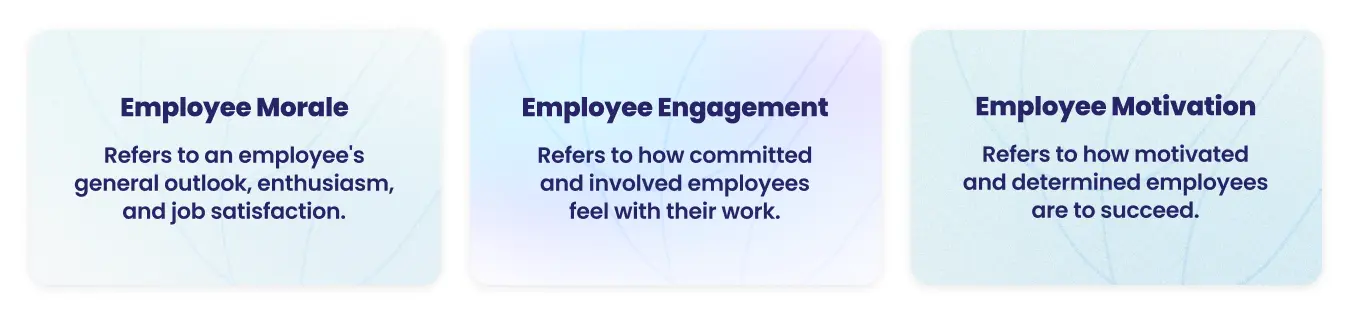
Morale is arguably the most important of the three factors, as it can influence the other two substantially. If you can make employees feel satisfied with their jobs, they'll naturally tend to become more engaged with their work and motivated to do well.
At first glance, it's easy to assume that high employee morale is only good news for the employees themselves, as it means that they're happy with their surroundings and situation. However, boosting employee morale can also have many knock-on positive effects on the company at large, driving productivity, efficiency, and long-term organizational success.
Business Performance and Profit: Companies with happy employees achieve a 20% higher performance rate compared to their competitors while engaged teams generate up to 21% higher revenue than disengaged ones.

Punctuality and Commitment: Businesses with higher employee morale are less likely to deal with absenteeism.
Retention Rates: Companies that work hard to improve employee job satisfaction tend to experience better employee retention rates, as employees don't feel the need to look elsewhere.
Customer Satisfaction: Even customers can benefit from higher employee morale, as happy team members tend to provide better customer service.
At a time when the majority of employees feel discontented and disengaged with their work, the value and benefits of a positive workplace culture cannot be understated. Boosting employee morale won't just improve productivity and punctuality, but could provide your company with a significant competitive advantage.
Employee morale isn't dependent on just one aspect. It's influenced by a whole spectrum of factors, from the company culture to the state of the work environment. Let's take a look at the full list of influences, and see what it takes to build a positive and supportive work environment.
For better or worse, every organization's leadership team has a lot of sway over the general mood of the workforce.
For example, leaders who tend to micromanage and are seen as excessively controlling, unapproachable, or even aggressive can drastically harm team morale. In contrast, leaders who are inspiring, demonstrate good emotional intelligence, and strike the balance between friendliness and professionalism tend to have much happier staff.
Therefore, it is important to stress to your leaders their role in maintaining and boosting employee morale. They must manage their habits and traits to both lead well and make employees feel valued and heard. For the best managers, this behavior often comes naturally, while others may require training or guidance from HR leaders to fine-tune their leadership skills.
It's human nature to want others to recognize our hard work, acknowledge our efforts, and reward us when we go the extra mile. Thus, it should come as no surprise that employee recognition is another key contributing factor in determining morale and mood among employees.
Let's say that an individual strives particularly hard to complete a tough project, for example. If their supervisor or peers fail to notice that effort, they may naturally feel not valued or appreciated, which could make them less keen to put in that same effort in the future.
Conversely, if that same individual receives praise, plaudits, and employee rewards for their hard work, they'll experience a clear morale boost.
With this in mind, it is important for business leaders to recognize employees and their efforts, and to reward employees who perform well and give their all. This not only helps to improve morale but also inspires other employees to work harder.
Work-life balance refers to the delicate balance between a person's professional and personal lives. Many people strive for a healthy work-life balance, especially younger generations.
This is understandable, as people want to enjoy their lives, and it can take a toll on their mental health if they feel overwhelmed or overworked, lacking time to spend with family and friends. However, some businesses fail to fully grasp this concept, encouraging employees to spend more time in the office or answer working calls outside of the usual hours, infringing into their personal time.
This is not good practice if you want to boost morale among your team members. Instead, it is better to promote work-life balance through various means, such as offering flexible working schedules or letting employees work from home sometimes.
Communication, or the lack of it, can also impact morale and employee mental health in general. This is just one of the reasons why clear, free-flowing communication is highly valued and promoted among the world's most successful organizations.
If employees feel that they have no clear lines of communication with peers, supervisors, or HR leaders, for example, they may endure in silence. They might have important employee feedback to share but aren't able to do so. Or, even worse, they could struggle with disputes or aggressive behavior from managers or colleagues, yet cannot report it.
Meanwhile, in businesses that value communication, employees feel empowered. They know that their voices are heard, and that they don't need to suffer silently or keep ideas and insights to themselves. In the long-term, this helps everyone, with happier and more engaged employees at every level.
For more than 90% of employees, career growth and professional development opportunities are extremely important. In fact, the majority of employees agree that there’s a higher chance for them to stay with a company if they see that there is room for them to grow, upskill, and improve.

Employees are more likely to have low morale in a company where they feel like they're stagnating, that they have no clear path of progression, and that their development is not a priority. They may feel that they're just seen as cogs in the business machine, rather than valued individuals with ambitions and potential.
To avoid such issues and to boost employee morale, businesses should find ways to support the growth and improvement of their team members. New employees should be onboarded in a structured, efficient manner, and shown examples of how they might progress with time. Loyal employees should also be rewarded with possibilities like training courses and mentorship initiatives.
Naturally, the nature of a person's work can also have a big influence on how much they enjoy it.
If an employee performs tasks they find enjoyable and fulfilling in a comfortable and safe environment, then, invariably, that employee feels more content than someone doing difficult, tedious, or otherwise unpleasant work. While there are certain elements businesses cannot control, other elements are within their control, and can be adjusted to make staff members' lives more pleasant.
In office environments, for example, you can't change the fact that certain tedious or repetitive tasks, like administration and data entry, need to be completed. But you can provide employees with helpful apps and proper tools to save them time, and ensure that their working environment is clean, comfortable, and pleasant to spend time in.
Company culture, too, can affect employee morale levels, and it's an aspect that is gaining increasing importance in the modern world.
Culture is, in essence, a summation of company values, attitudes, and ways of working. Some companies have employee-focused cultures, like a clan culture where employee well-being and togetherness are top priorities. Others are more driven by a hierarchical structure, or are all about taking risks and out-of-the-box thinking.
People respond differently to different types of company culture. Having a positive culture in which aspects like communication, teamwork, and unity are emphasized will generally help to improve employee morale. It is also wise to focus on recruiting people who fit well with the existing culture. This eases their onboarding and helps with the adaptation phase.
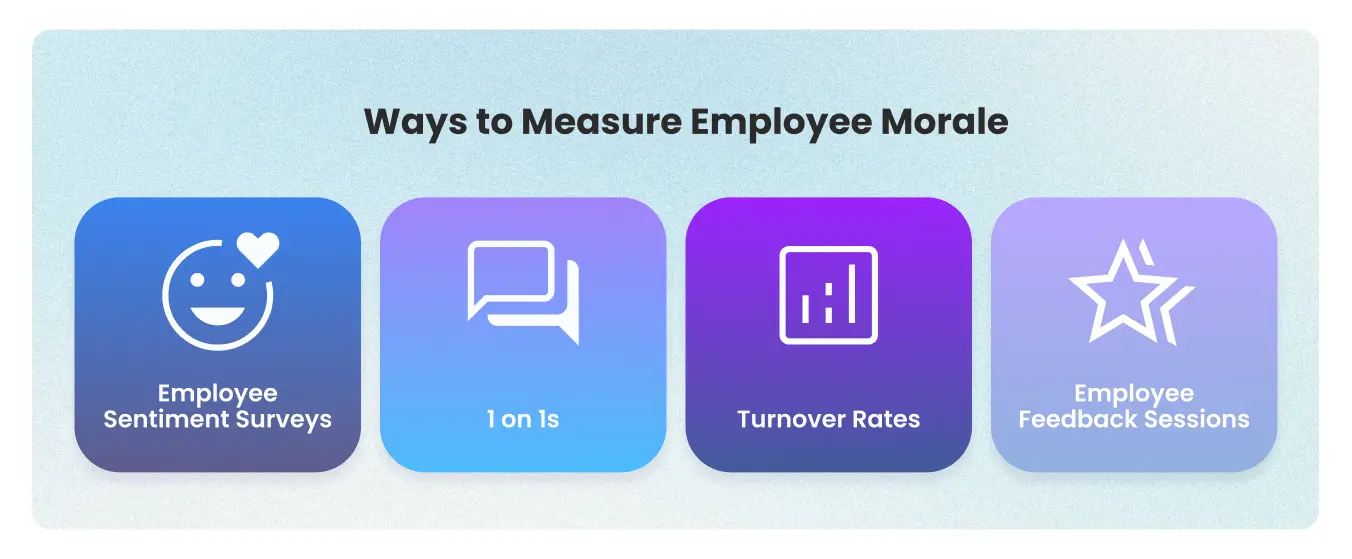
If you want to inspire and motivate employees and build a more productive workplace, you need to know how to measure employee morale. There are numerous ways to do this, which we'll explore below.
One of the easiest and most common ways of measuring employee happiness is through surveys.
You can issue brief, frequent pulse surveys, enabling managers to keep their finger on the "pulse" of the workforce. Or, you can utilize more long-form employee feedback sessions, with questions about job satisfaction, workplace culture, and the level of care and support each employee receives.
Another take on the feedback form or survey is to host regular one-on-one meetings with your team.
There is a lot of value in this, as many employees prefer opening up in one-on-one discussions, especially those who might otherwise remain quiet during group discussions. The intimacy of this kind of meeting helps many employees feel more willing to share their thoughts. It's also a chance for managers to practice employee recognition and praise employees for their efforts, which can boost employee satisfaction.
You can also learn a lot about the overall employee experience and morale levels by monitoring various performance metrics.
Productivity and profitability, for example, aren't just indicators of business success. They can also tell you how focused and satisfied your staff is. Productivity levels often dip in correlation with morale. Other metrics also provide further insight. Absenteeism, for instance, is often higher in companies with morale problems.
Employee retention rates and turnover rates are valuable, additional metrics for measuring morale.
High employee retention is a good indicator of employee satisfaction. Team members who are unhappy are more likely to look for other employment opportunities in places with more benefits or a better culture. Consider conducting exit interviews with departing employees to find out what you could do better. Analyzing these trends proactively allows for early intervention and prevents further losses.
If your workplace encourages communication (which it should, if you want to maintain high morale), then employees should feel willing to share both positive feedback and constructive criticism about the overall employee experience.
Seek this feedback, whether it be through surveys, anonymous submissions, one-on-ones, or larger group discussions. However, don't just acknowledge and file the feedback you gather. Listen to it and analyze it. Look for patterns or common themes to spot areas of improvement.
A more anonymous and intuitive way to learn about employee morale is to simply observe employees in the course of their day-to-day duties.
Pay close attention to the team dynamics, and how each team member interacts with their peers. In spaces with positive atmosphere and strong morale, employees tend to be more collaborative, communicating freely with one another, exchanging ideas and support. Conversely, in workplaces with poor morale, you can almost sense the tension in the air, with a lack of communication and expressions of frustration.
Just because some staff members seem happy, it doesn't necessarily mean that you don't have to worry about low morale. Other workers may be struggling silently with various issues.
As such, it is important to take a holistic approach, not just paying attention to individual employees or groups, like a leadership team. Instead, seek feedback and viewpoints from employees at all levels to get a complete picture, spot the gaps in morale, and see what can be done to address them.
If you want your business to prosper, focus on the people who keep it running. By cultivating a positive culture and promoting employee morale, you can experience boosts to productivity, employee retention, and so much more.
Motivosity's people-first recognition and rewards platform is the perfect tool to elevate morale with minimal effort and a streamlined process. Contact our sales team today to find out how it can help you.