
.png)
Culture and people continue to be powerful retention anchors. In fact, 83% of employees say they stay with an organization primarily because of its culture and the people they work with, according to new research conducted by HR.com in partnership with the employee engagement platform Motivosity.
Specifically, a culture of recognition can contribute to a positive overall culture. However, over a third of employees never or infrequently receive meaningful recognition from either their peers (35%) or direct manager (37%).
Leadership plays a key role in establishing a positive culture, and a lack of trust in leadership can undermine it. Although most respondents feel connected to their immediate teams and direct managers, many lack trust in overall leadership.
The study also found that, although most respondents say they stay at a company primarily for its culture and people, many organizations undermine this retention anchor with self-inflicted wounds such as a lack of clear communication, high levels of change fatigue, and a scarcity of meaningful recognition.
Moreover, most organizations may not even know the extent of their problems due to a high degree of “data blindness.” A majority (59%) of managers and executives do not know their organization’s Net Promoter Score (eNPS), a metric measuring employee engagement and loyalty based on the likelihood that they recommend their company as a good place to work.
Fortunately, this is a solvable challenge. Organizations that adopt modern listening and analytics platforms can quickly bridge this gap, moving from reactive guesswork to proactive cultural management. This is part of a clear path forward. The study finds that a cohort of “culture leaders” (those with strong workplace cultures) operate dramatically differently. Employees in such organizations are over eight times more likely than those in “culture laggard” organizations to trust their leadership to a high degree, and they are nearly 16 times more likely to receive meaningful recognition from their managers on a weekly basis.
This study takes a close look at what’s driving workplace culture and connection, the challenges organizations face, and the practices that set those with stronger workplace cultures apart from others.
* Please note that the findings and recommendations contained in this report are informational only. Nothing in this report should be construed as constituting legal opinions or advice. Please consult an attorney if you have questions about the legal requirements, rules, or regulations associated with any content discussed in this report.
.png)
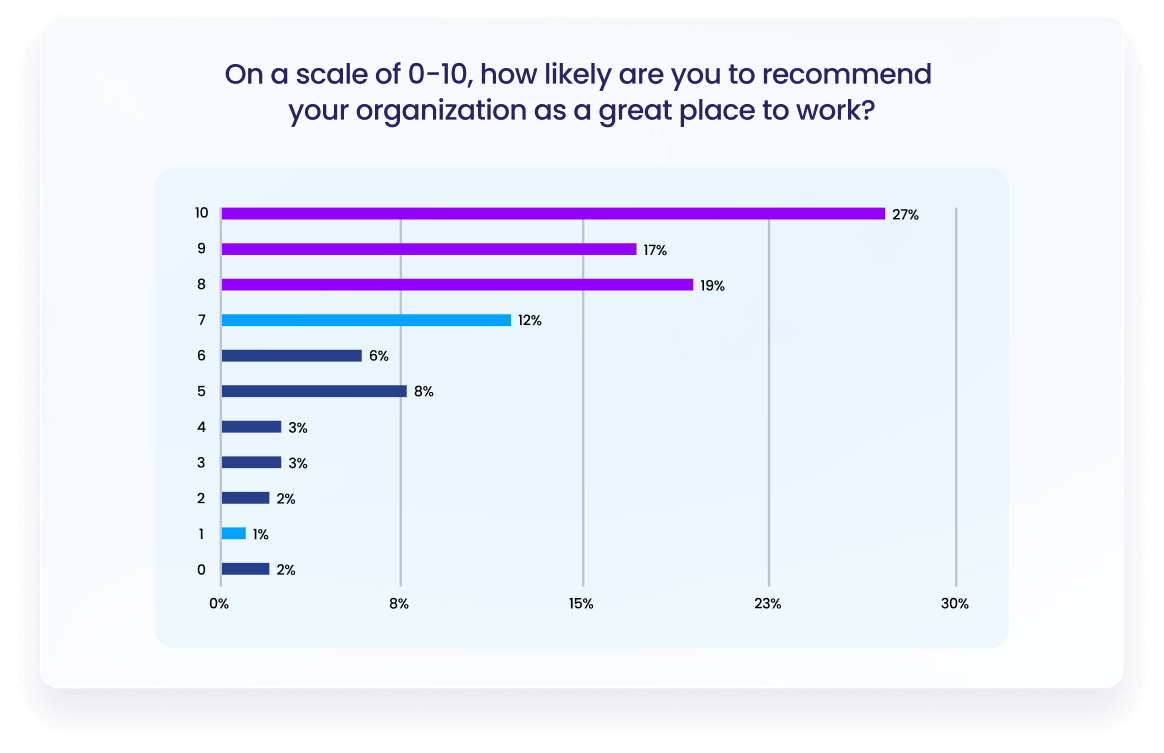
There is good and bad news when it comes to employees’ view of their employers. The good news is that when asked how likely they are to recommend their organization as a great place to work, 63% gave a rating of 8 or higher (0 being very unlikely and 10 being highly likely).
The bad news is that this still leaves over a third of employees are less-than-enthusiastic about their organizations. Twelve percent are only somewhat likely (7 out of 10) to recommend their workplace as a great place to work, leaving about a quarter who are reluctant to recommend their employer (6 or below).
.png)
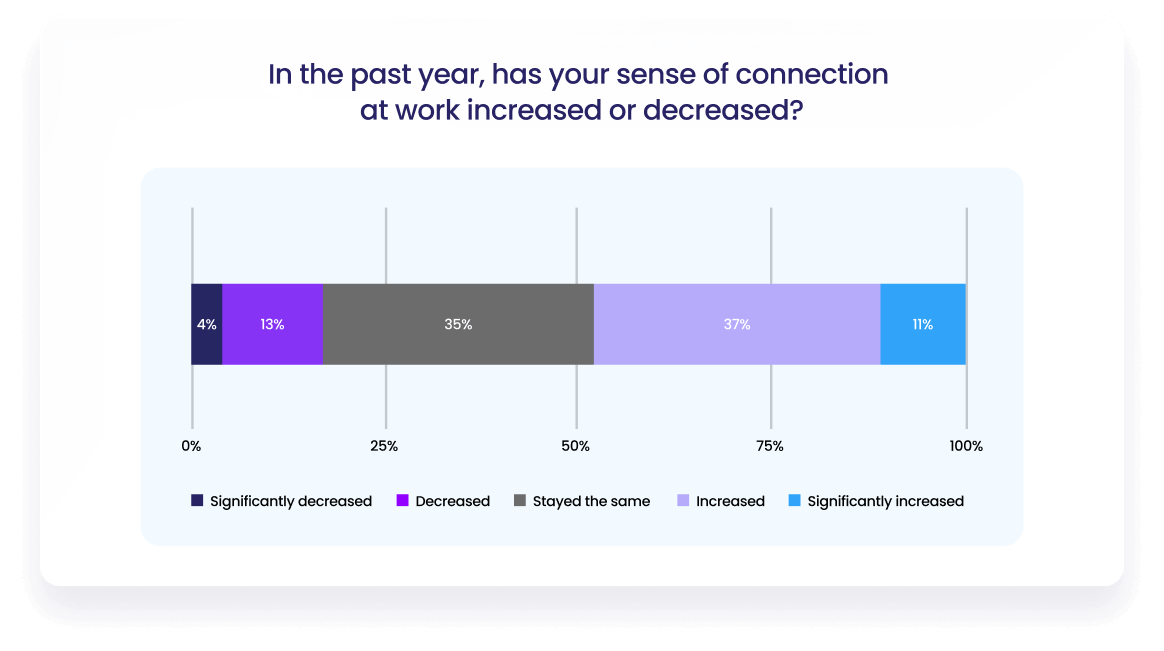
A sense of connection (or lack thereof) can make or break a workplace. When we look at the past year, nearly half (48%) of respondents say their sense of connection at work has increased (37%) or significantly increased (11%). Later in this report, we explore reasons for this increase, as well as give suggestions as to how to further increase a sense of connection in the workplace based on our data.
What differentiates organizations with a stronger culture from others? To examine this question, we divided our data set into two cohorts based on how likely they are to recommend their organization as a “great place to work.”
Culture leader organizations: These are organizations whose employees responded 8-10 to the statement, “On a scale of 0-10, how likely are you to recommend your organization as a great place to work?”
Culture laggard organizations: These are organizations whose employees responded 0-6 to the same statement.
Correlation does not necessarily indicate causation, of course, but these relationships may provide clues about possible best practices the area of employee engagement and recognition.
.png)
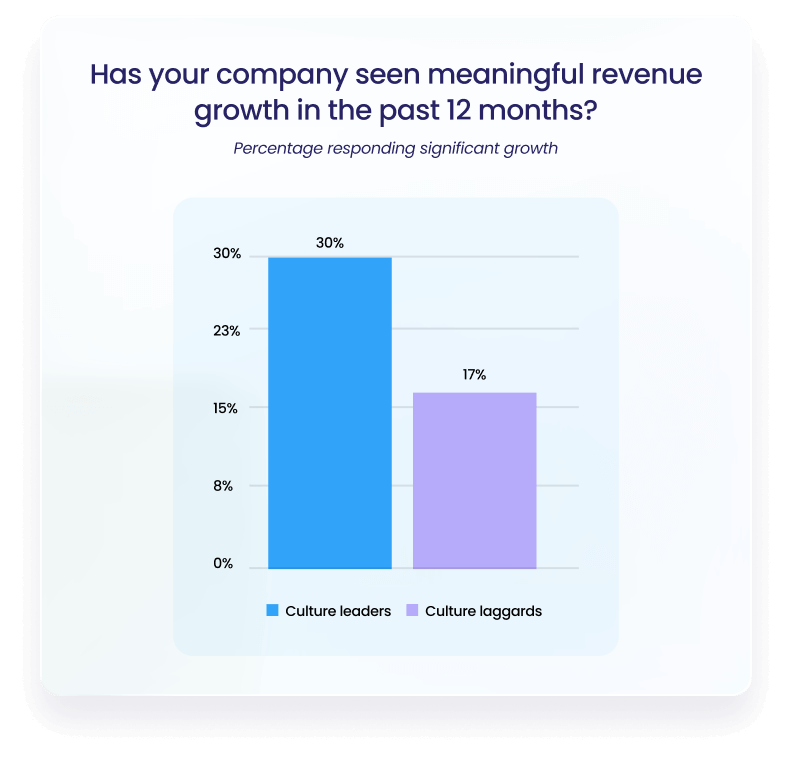
The degree to which there is a return on investment (ROI) on culture is often debated in business circles, but the data here is clear: organizations with thriving cultures are also more likely to thrive financially.
Culture leaders are nearly twice as likely as laggards to report significant revenue growth in the past year (30% vs. 17%). This suggests that culture is not just a byproduct of success but a means of generating success. When employees feel connected, recognized, and supported, the business performs better.
.png)
A positive work environment is essential for retention. This research shows that 83% of respondents stay at a company primarily for its culture and people, making continuous investment in culture a requirement.
But what defines a positive environment? Work-life balance (47%) is the top factor impacting culture, followed by employees’ immediate peers (37%). Rounding out the top three is communication and transparency (33%). While work-life balance highlights the need for flexibility, the importance of immediate peers and communication suggests that culture is most vibrant when that flexibility is paired with connection.
Other significant factors related to company culture are respondents’ direct managers (31%) and the company mission and values (28%). Since employees frequently interact with their direct manager, it comes as no surprise they influence employees’ perception of the culture. Furthermore, a company’s mission, vision, and values are often a reflection of an employee’s own values. If there’s misalignment, there’s a good chance employees will start searching for employment elsewhere. In fact, a LinkedIn study found 87% of workers in the U.S. consider it important to work for companies aligned with their values.
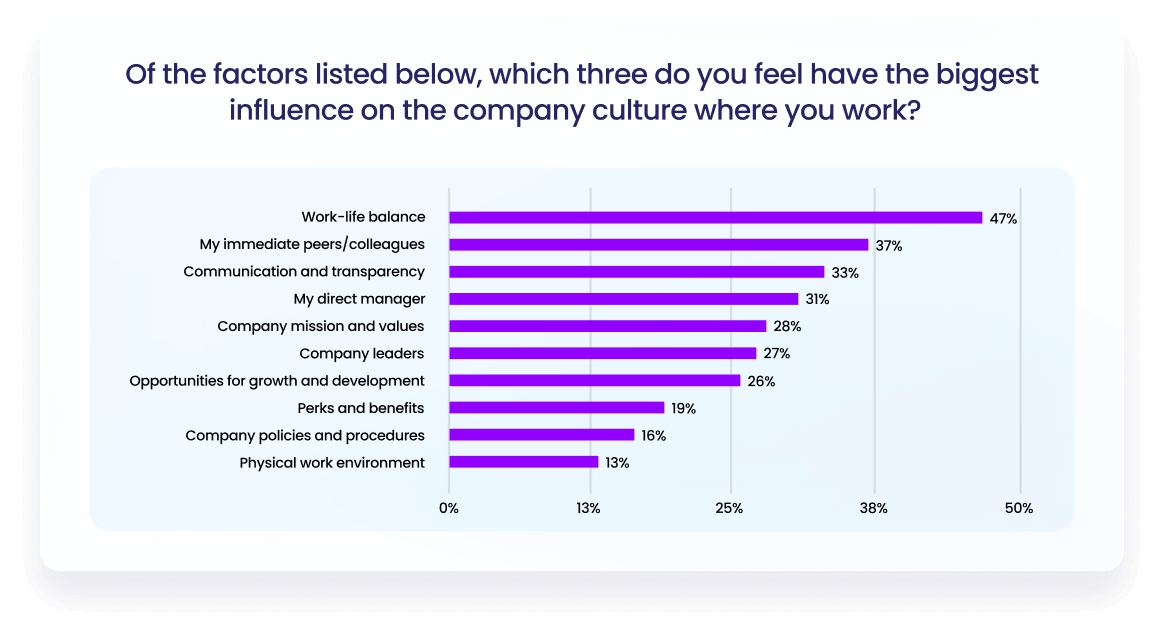
Differences by age: Younger employees (34 and under) are significantly more likely to cite opportunities for growth and development as a top cultural influence (41%) compared to the 45-54 group (23%) and the 55+ group (19%). Similarly, this youngest cohort places a much higher value on communication and transparency (36%) than the 35-44 group (31%) or the 55+ group (29%). Organizations that fail to validate clear career pathways or maintain open lines of communication risk disengaging this critical talent pool early in their tenure.
.png)
.png)
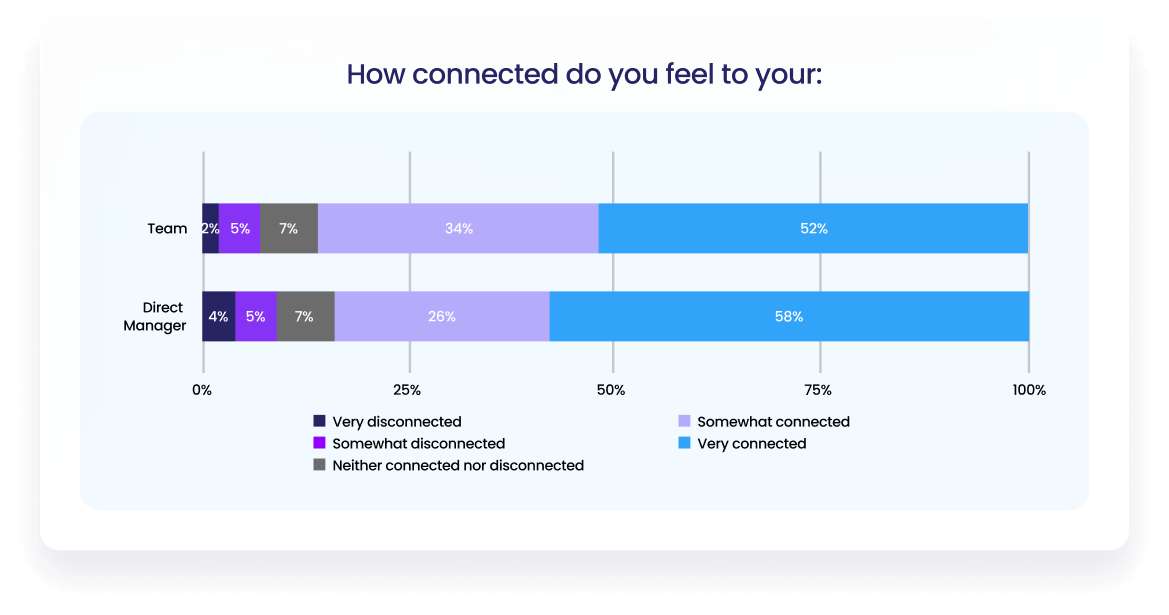
We took a closer look at employee dynamics with their direct manager and team. Most employees feel somewhat connected (34%) or very connected (52%) to their teams (86%). A similar proportion (84%) say the same about their direct managers. While individual experiences vary, these numbers indicate a healthy baseline for the future of workplace culture.
.png)
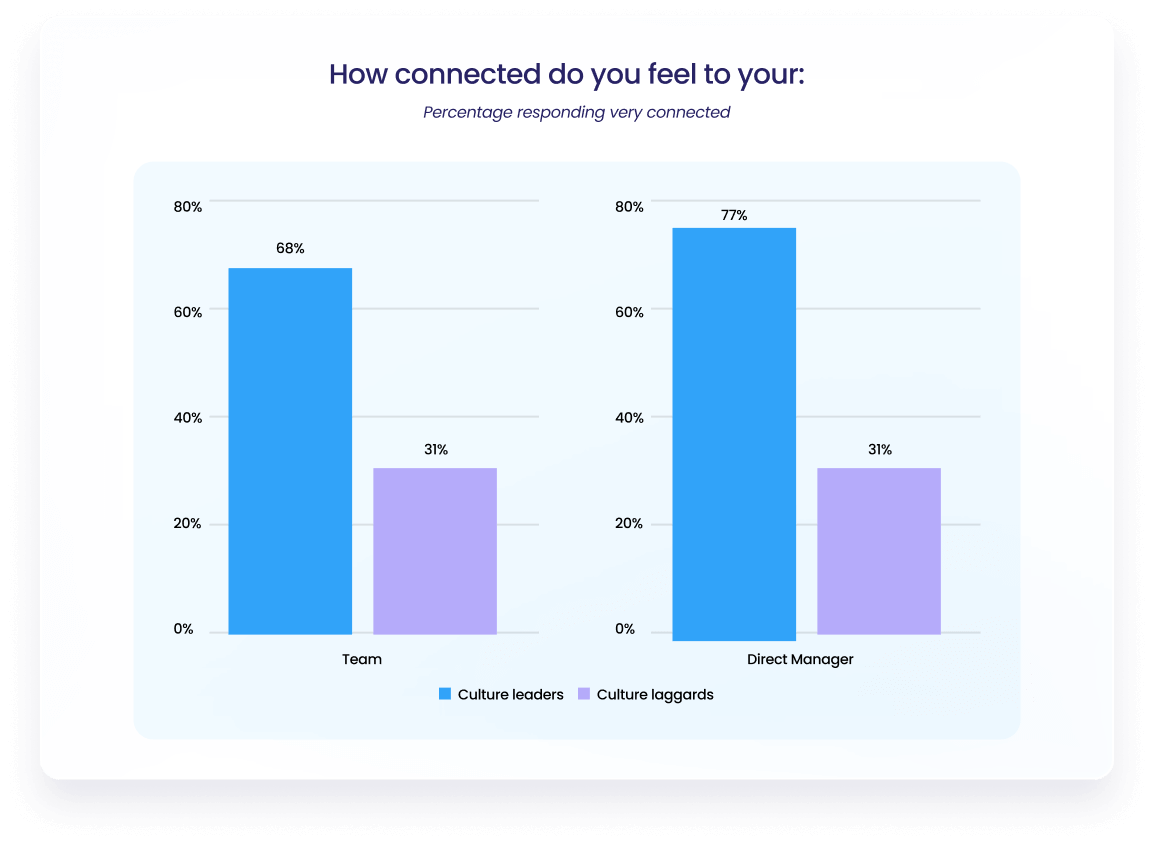
Respondents from culture leaders organizations feel significantly more connected at work. In fact, they are more than twice as likely as laggards to say they feel a strong sense of connection to both their team (68% vs. 31%) and their direct manager (77% vs. 31%).
This wide gap confirms that strong camaraderie is not just incidental to a positive work environment—it is a defining feature of it.
A chi-square test of independence shows that culture leaders are significantly more likely than the laggards to feel very connected to their team and direct managers.
Based on our research, below are a couple of suggestions:
Treat interpersonal connection as a useful metric.
The data from culture leaders shows that connection is not just a “nice to have,” it is an important element of culture. Track it with the same rigor as you would performance or productivity.
Investigate what creates connection in your workplace.
Pay attention to teams that have a strong connection to determine which practices and attitudes drive that feeling in your organization.
Implement quarterly manager-employee connection check-ins.
Train managers to hold structured connection-focused conversations (separate from performance reviews) every quarter. Track participation, themes, and follow-up actions to ensure progress is visible and consistent.
Provide managers with targeted training on relationship-building skills.
Prioritize skills like trust-building, active listening, and inclusive communication. Deliver role-based training and track improvements through 360 feedback results or midyear engagement indicators.

.png)
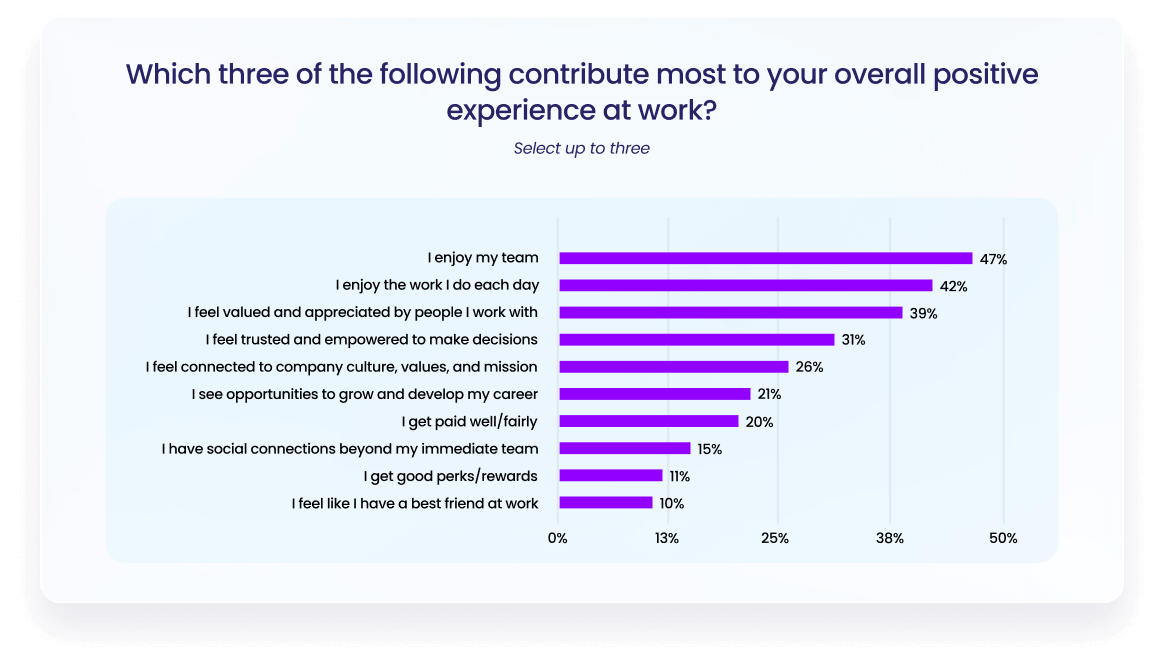
Enjoying one's team (47%) is the leading contributor to a positive work experience, followed by enjoying their daily work (42%) and feeling valued by colleagues (39%). These findings further support the importance of connection in the workplace. A substantial but smaller proportion say that getting paid well/fairly (20%) and good perks and rewards (11%) are highly likely to contribute to their overall positive work experience.
This data suggests that while organizations shouldn’t forget about pay, perks and rewards, they should also be placing considerable effort on workplace culture and connection.
The findings of this report are supported by other research as well. For example, a Harris Poll survey found that 89% of U.S. hiring managers say employees are more likely to stay with a company if they have friendships in the workplace, with 42% strongly agreeing with this statement
.png)
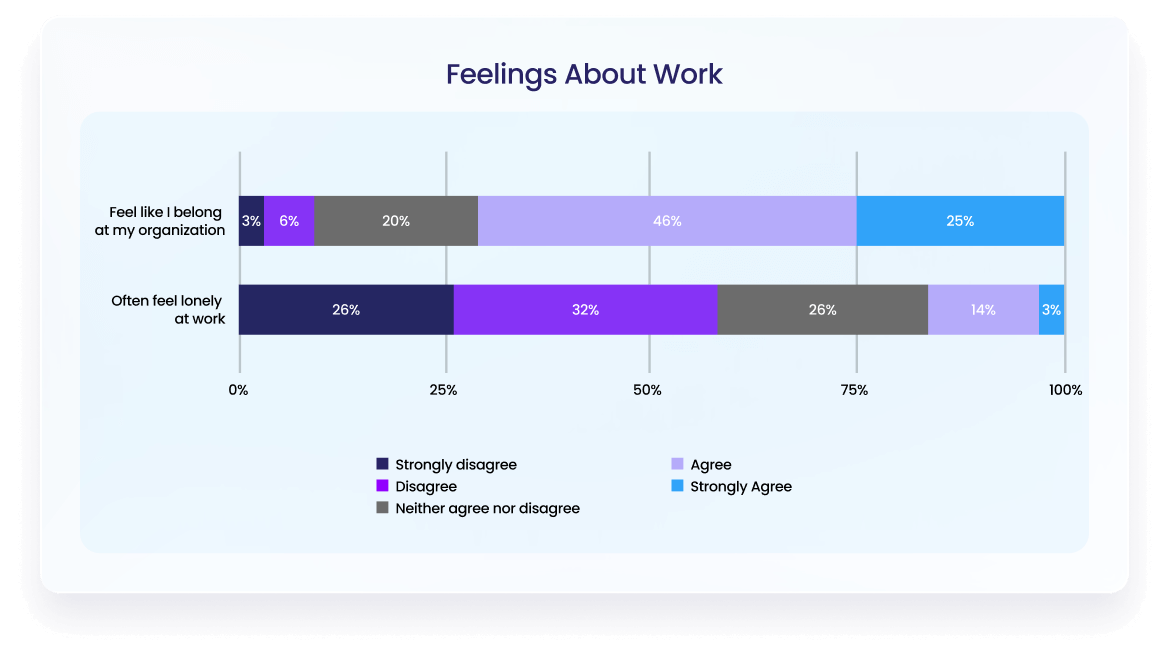
Most employees derive a sense of belonging at work. A large majority (71%) agree or strongly agree they belong. And 58% actively disagree they often feel lonely at work.
Does this mean the so-called “loneliness epidemic“ doesn’t exist? Not really. In 2024, Gallup research stated one in five employees very, often or always feel lonely. Similarly, this report finds that 17% of employees agree or strongly agree they often feel lonely at work.
While most employees in this survey report feeling connected, it is still important to consider the subset who do struggle to belong or report feeling lonely. These employees represent an opportunity for organizations to strengthen inclusion, connection, and culture.
.png)
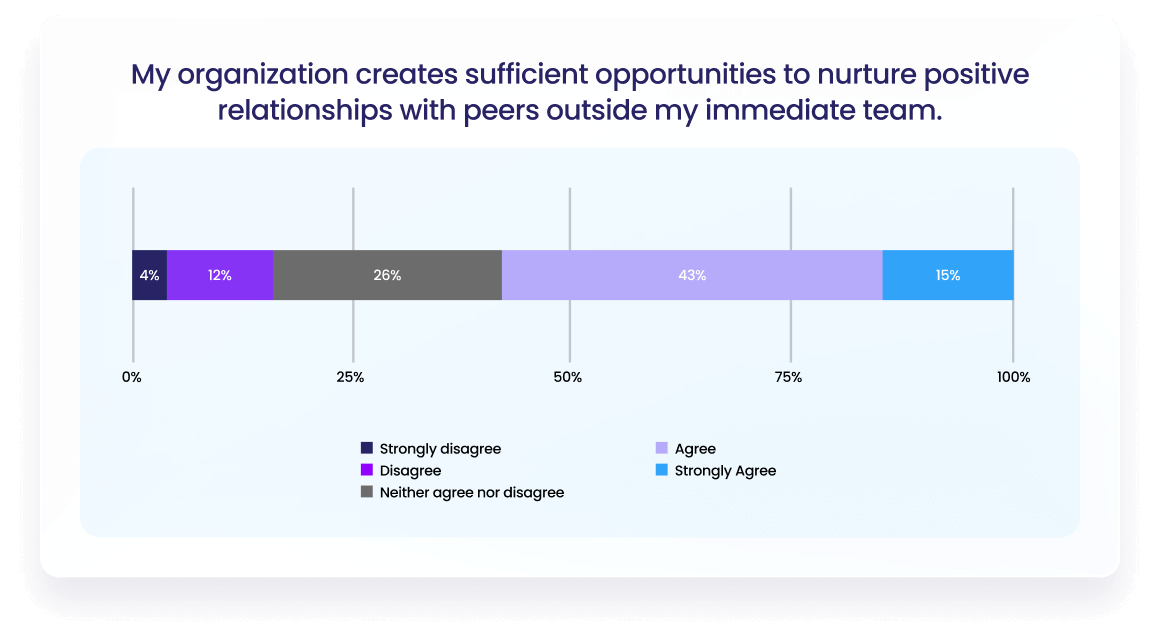
A strong workplace culture is often driven by the relationship with one’s team. However, the relationships outside of one’s immediate team also matter. They can help generate new ideas, break down silos, achieve cross-team goals, and are better at problem solving. Our study found 58% of respondents agree or strongly agree their organization creates sufficient opportunities to nurture positive relationships with peers outside their immediate team.
While that seems like a positive finding, it is also important to note this percentage is significantly lower than the 86% who say they are connected to their team. While immediate teams are tight-knit, the broader organizational glue is significantly weaker. Many organizations will have to put effort into nurturing cross-functional relationships to create a stronger culture.
.png)
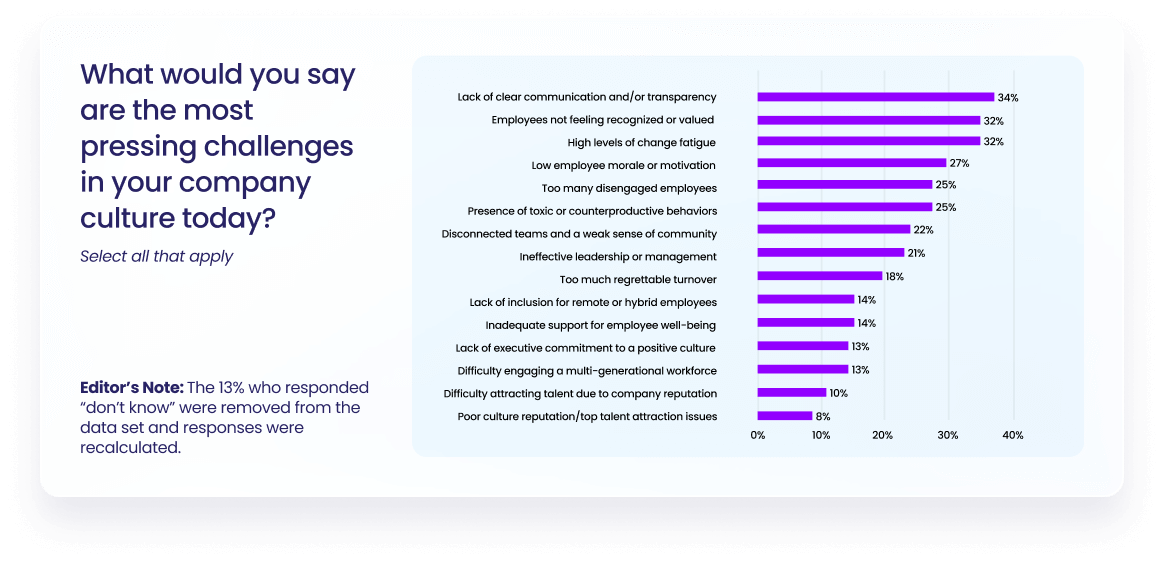
No company culture is perfect, but some challenges are more common than others. The greatest of these is a lack of clear communication and transparency. At best, a lack of clarity creates frustrating but relatively minor issues such as task ambiguity. At worst, it creates an environment where larger issues such as discrimination can take root, specifically when decision-making happens behind closed doors and excludes specific groups.
At the number two spot, however, is a much more personal challenge: employees not feeling recognized or valued. And, that issue is likely related to the others rounding out the top five challenge: that is, change fatigue, low morale, and disengaged employees. When an employee’s hard work goes unnoticed, it starts out as a minor issue. Then, if they’re continuously feeling devalued, it leads to a death by a thousand cuts situation, where they become less engaged and stop caring about putting effort. Low morale can lead to greater change fatigue and eventual turnover. Once they leave, it brings about disruptive changes for the team, with other members of the team often having to pick up extra work. A burdened team is likely to have low morale and eventually check out. This continues the toxic cycle unless organizations fix the lack of recognition.
.png)
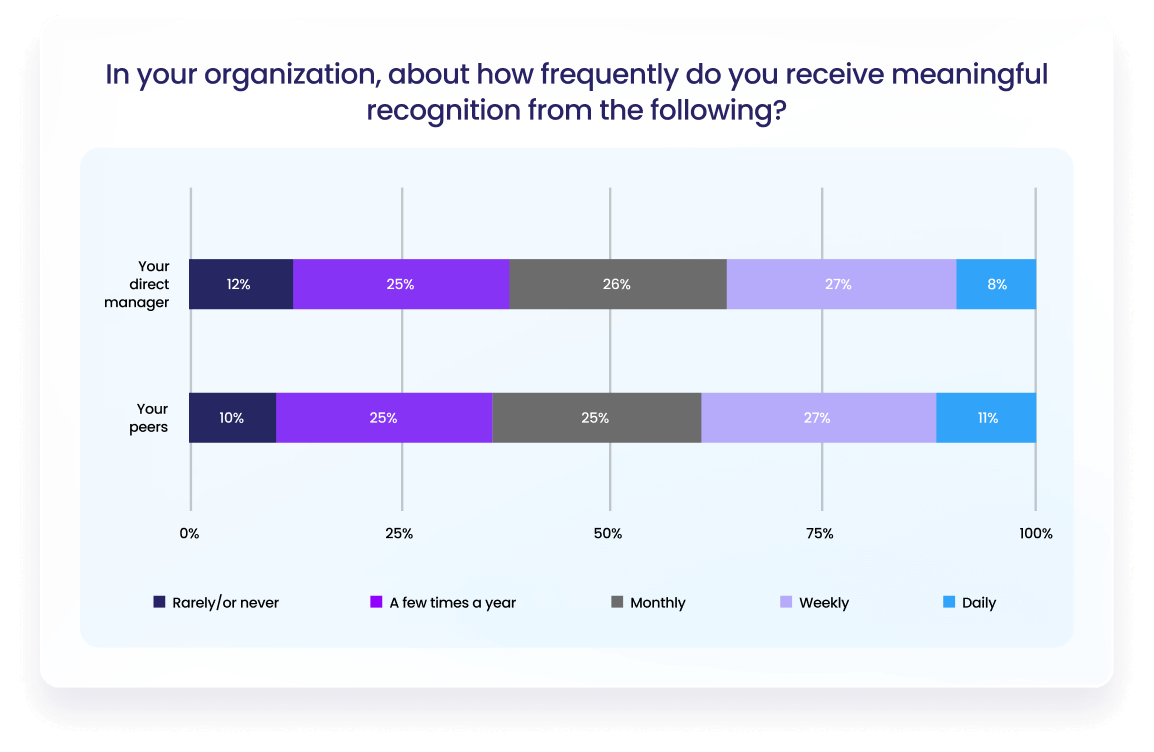
Earlier in this report, we found respondents are slightly more likely to feel connected to their team than to their direct manager. Mirroring that earlier finding, respondents are also slightly more likely to receive meaningful recognition from their peers (38%) than their direct managers (35%) on a daily or weekly basis.
However, a large “recognition gap” persists. Over a third of employees rarely or never receive meaningful recognition from either their peers (35%) or direct manager (37%). Organizations should provide managers with the tools and training they need to make appreciation a core part of their weekly management style. This could include manager-specific resources such as an automated employee recognition tool that integrates with your existing software or 1-on-1 templates that explicitly prompt for weekly wins. Whatever tools and training are implemented, they need to be consistent, intentional habits that ensure every employee feels valued for their work.
.png)
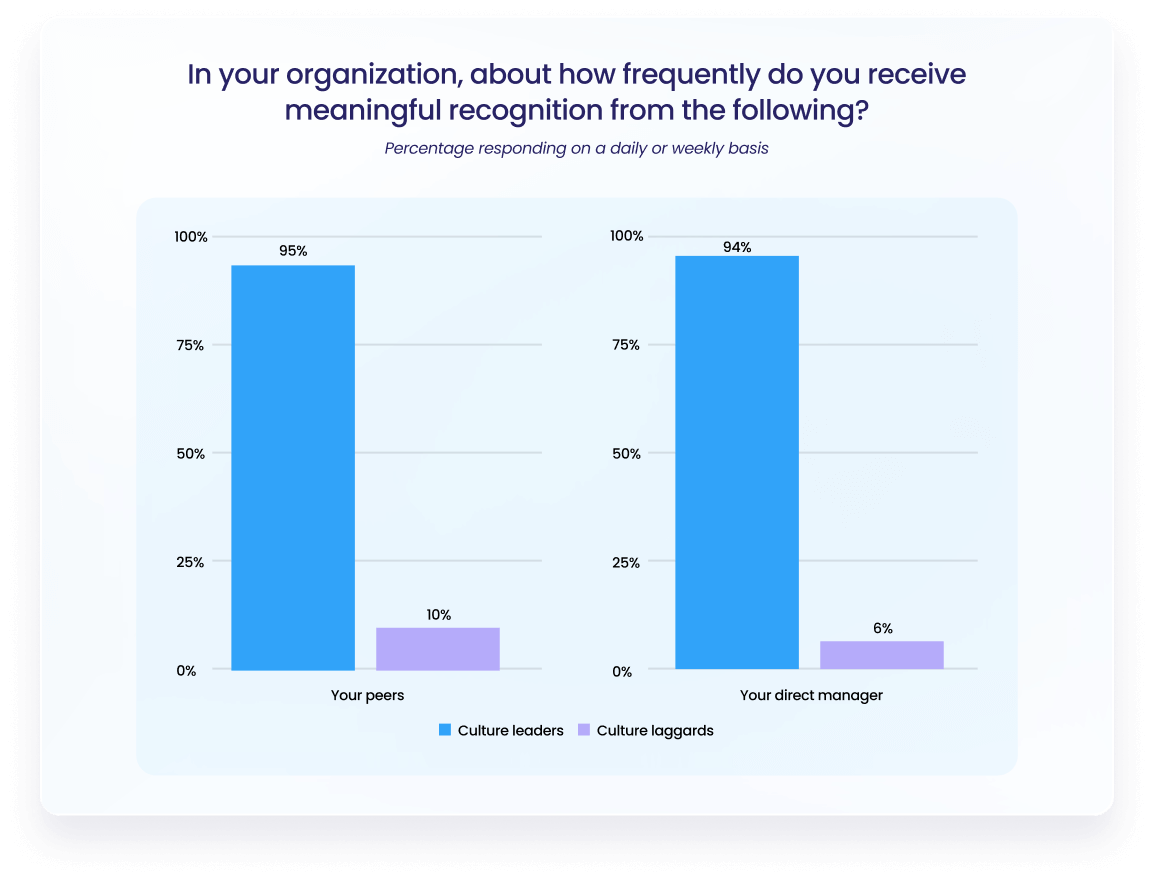
Employees at culture leader organizations are much more likely to be recognized frequently than those at culture laggard organizations.
In fact, they are nearly 16 times more likely to receive meaningful recognition from their direct manager on a daily or weekly basis (94% vs. 6%). They are also over nine times more likely to receive frequent recognition from their peers (95% vs. 10%). This result further supports the link between meaningful recognition and how much culture leaders feel connected to their teams and direct managers.
Based on our research, below are a couple of suggestions:
Teach managers the importance of daily or weekly recognition.
Managers who give recognition every month or two may feel they are doing enough. However, the data shows that daily or weekly recognition makes a difference. Train managers to view recognition as a consistent habit, not a periodic task.
Share data on recognition with your managers.
Track recognition frequency by team and alert managers when their activity drops too low. Use this data to drive accountability, not just awareness.
Encourage peers to show recognition.
Ensure employees understand that one way they can create a positive culture is to show recognition to their peers. Provide guidance on how best to do it.
.png)
.png)
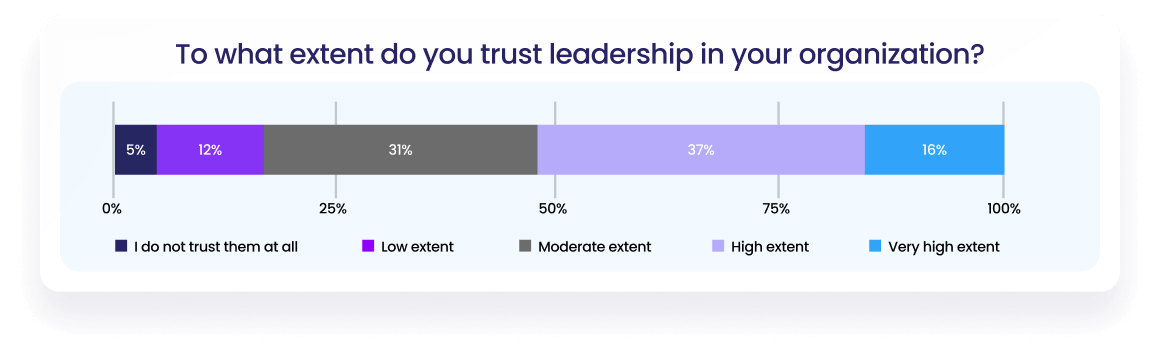
Trust is the currency of leadership, and accounts are running low these days. Nearly half of all respondents (48%) report having only moderate to low trust in their organization's leaders.
This “trust deficit” is a critical vulnerability. Without high trust, organizations struggle to navigate change or retain top talent.
Leaders in these organizations need to determine what the root cause of this lack of trust is and what steps they can take to improve trust in their organization.

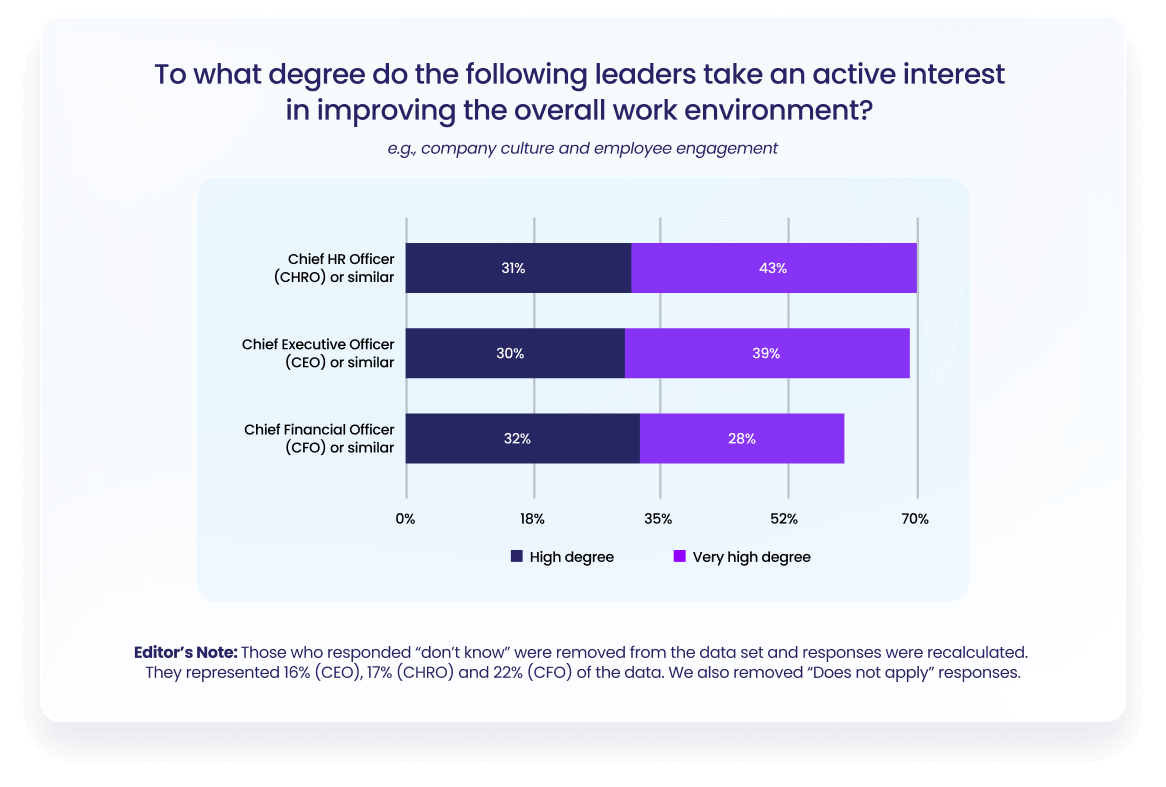
The exact reasons for a lack of trust in leadership vary by organization, but a perceived lack of interest in improving the overall work environment could be a driver. We asked managers and executives to report on the degree to which CHROs, CFOs and CEOs in their organization take an active interest in improving the work environment.
Out of the C-suite executives, the CFO is typically the least likely to take an active interest in this area. Given that improving the work environment necessitates the strategic allocation of financial resources and budget approvals, the CFO's minimal engagement in this area undermines the organization's ability to foster a supportive workplace.
Among employees at culture leader organizations, 83% say they trust leadership to a high or very high extent. In contrast, among those at culture laggard organizations, a meager 10% say they trust leadership to a high or very high extent. This huge gap is a major finding in this study.
Differences by type of role: While C-suite leaders often believe they are championing culture, too often managers and employees aren't seeing it. We found a consistent, double-digit gap between how executives view their own involvement and how managers and employees perceive it. For example, 69% of executives say the CEO takes a high or very high interest in improving the work environment, but only 52% of managers and employees agree.
The same story holds true for the perceived investment of CFOs (60% vs. 39%) and CHROs (71% vs. 54%), illustrating that while leaders may feel invested, their actions are not visible enough to the people leading their teams. This “visibility void” is risky. If managers and employees do not perceive the C-suite as active partners in building culture, they are less likely to champion those initiatives themselves.
.png)
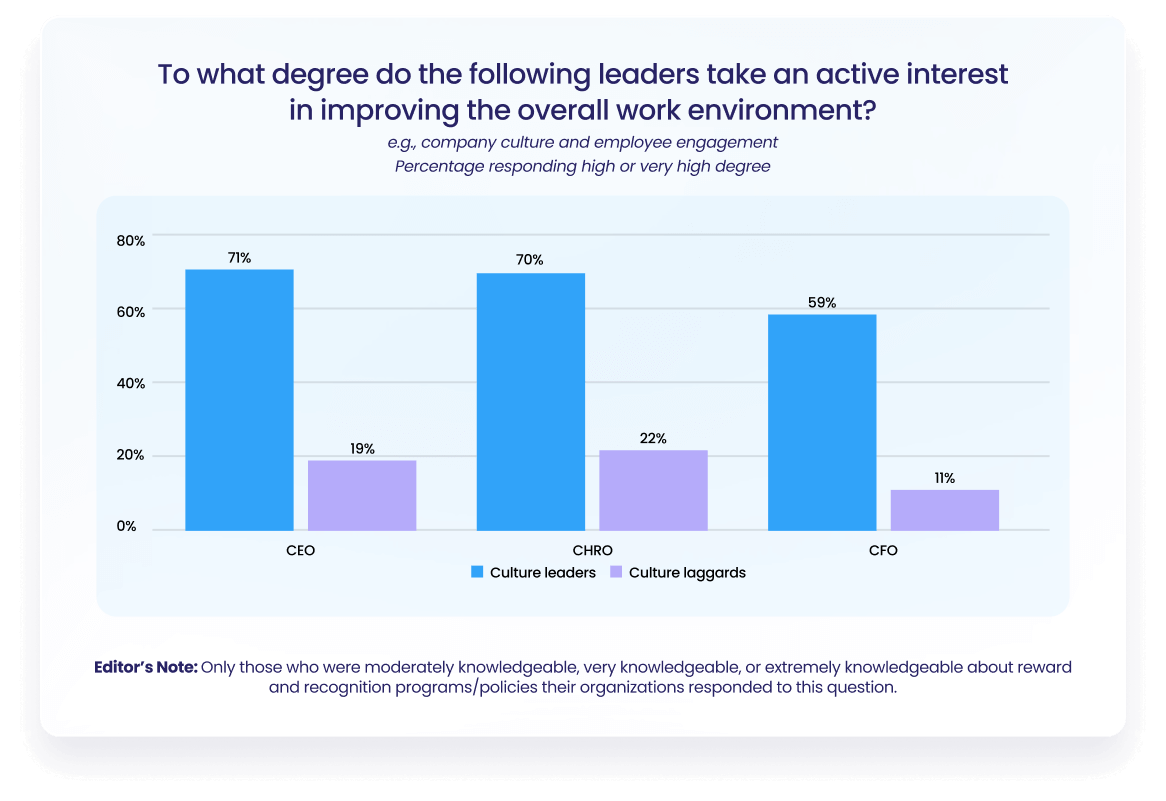
Executive involvement is a defining characteristic of strong cultures. In culture leader organizations, the entire C-suite is perceived as active participants in the work environment, not just observers. More specifically, CFOs in culture leader organizations are over five times more likely than their laggard counterparts to be seen as taking an active interest in making positive changes. CEOs and CHROs in culture leader organizations are over three times more likely to take an active interest in improvements.
This visible interest from the top apparently pays dividends in trust. Leaders are over eight times more likely than laggards (83% vs. 10%) to say they trust leadership in their organization to a high or very high degree.
A chi-square test of independence shows that culture leaders are significantly more likely than the laggards to say their CEO, CHRO and CFO take an active interest in improving culture.
Based on our research, below are a couple of suggestions:
Treat the work environment as a team sport.
The data shows that in culture leader organizations, senior executives tend to take an active interest in the work environment. Ensure everyone in the C-suite is on the same page when it comes to creating the right work environment.
Gather metrics on the work environment.
Objective feelings are hard to manage; hard numbers are not. Use metrics such as eNPS, retention rates, and recognition frequency to ground leadership discussions in reality. This data is essential for engaging the CFO and other analytical leaders.
Set a high bar for leadership involvement.
The data emphasizes a high or very high degree of active interest. A passing interest is insufficient. Challenge your leaders to move beyond “approving” culture initiatives to actively participating in them—whether through town halls, visible recognition, or direct mentorship.
.png)
Increased employee engagement (49%) is ranked as the top goal for company culture. To help achieve this, organizations need to focus on the ideas of team enjoyment and belonging. Deloitte’s Human Capital Trends report has consistently found that belonging and strong team relationships are among the most powerful predictors of engagement, well-being, and intent to stay.
Many (41%) also cite improving leadership/management skills and engagement and increasing employee productivity (40%). These goals are deeply interconnected. Culture is built from the bottom up. Without a solid foundation, company culture begins to fall apart. Organizational leaders must create structure through modeling company values, tools and processes, thereby encouraging employee empowerment. This sense of ownership strengthens feelings of belonging, engagement, and productivity.
.png)
.png)
An overwhelming majority (90%) of employees believe feeling appreciated and valued improves their performance. However, while organizations prioritize engagement and culture, they aren’t necessarily investing in engagement practices and tools in meaningful ways.
A third of organizations aren’t measuring employee engagement, and 44% don’t have recognition platforms/programs. This makes it difficult for organizations to overcome top challenges such as employees feeling they aren’t being recognized enough and disengagement. Organizations may not even be aware they have issues if they aren’t investing in (or simply failing to use) engagement-related tools.
Further, there are bigger issues when it comes to tools that actively build relationships and skills. A large majority do not use:
The bottom line is that organizations seem to recognize that engagement matters, but they haven't yet committed to the actual practices, such as recognition and structural support, that turn good intentions into reality.
.png)
.png)
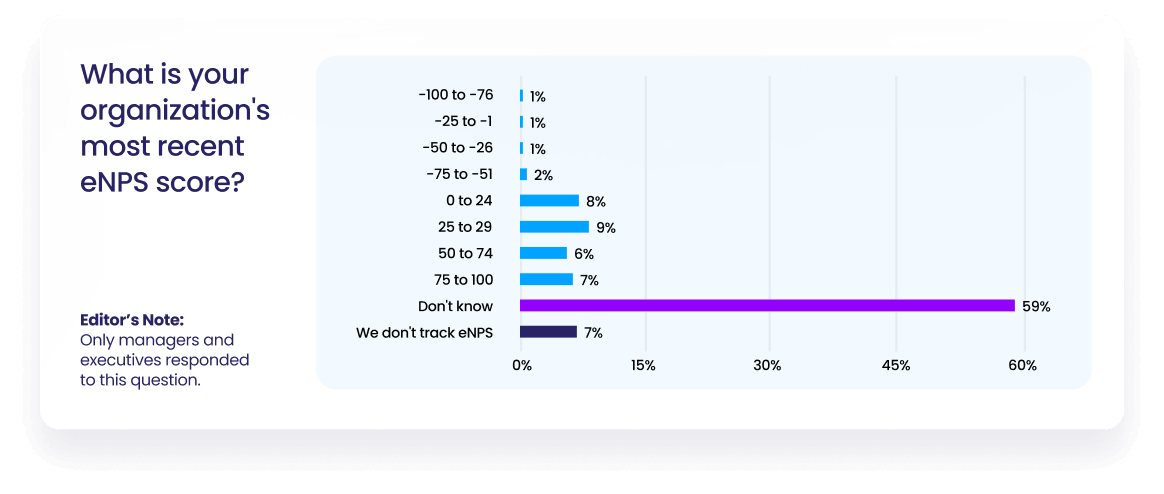
There is a startling disconnect between data collection and data awareness. Based on a previous question, we know that most organizations use some sort of employee surveys to influence engagement. However, a majority of managers and executives (59%) do not know their organization's most recent Employee Net Promoter Score (eNPS).
Derived from customer loyalty metrics, Employee Net Promoter Score (eNPS) measures workplace satisfaction. Employees rate their likelihood to recommend the company on a scale of 0–10. The final score, ranging from -100 to +100, is calculated by subtracting the percentage of Detractors from Promoters.
When combined with the 7% who do not track eNPS at all, nearly two-thirds of organizations are operating without clear visibility into this metric. We should note that it is possible that some of the managers and executives who respond “Don’t know” are simply not sure whether or not their organizations actually use some form of eNPS.
Regardless, these responses indicate a lack of knowledge among executives and managers about the degree to which employees would recommend their companies to other people seeking work. Without understanding the eNPS baselines, leaders are effectively “flying blind,” unable to target interventions to the teams or departments that need them most.
It isn’t all bad news, however. Among the 35% that know their eNPS numbers, most report positive scores, and 25% of that subgroup report an excellent score of 75 to 100.
.png)
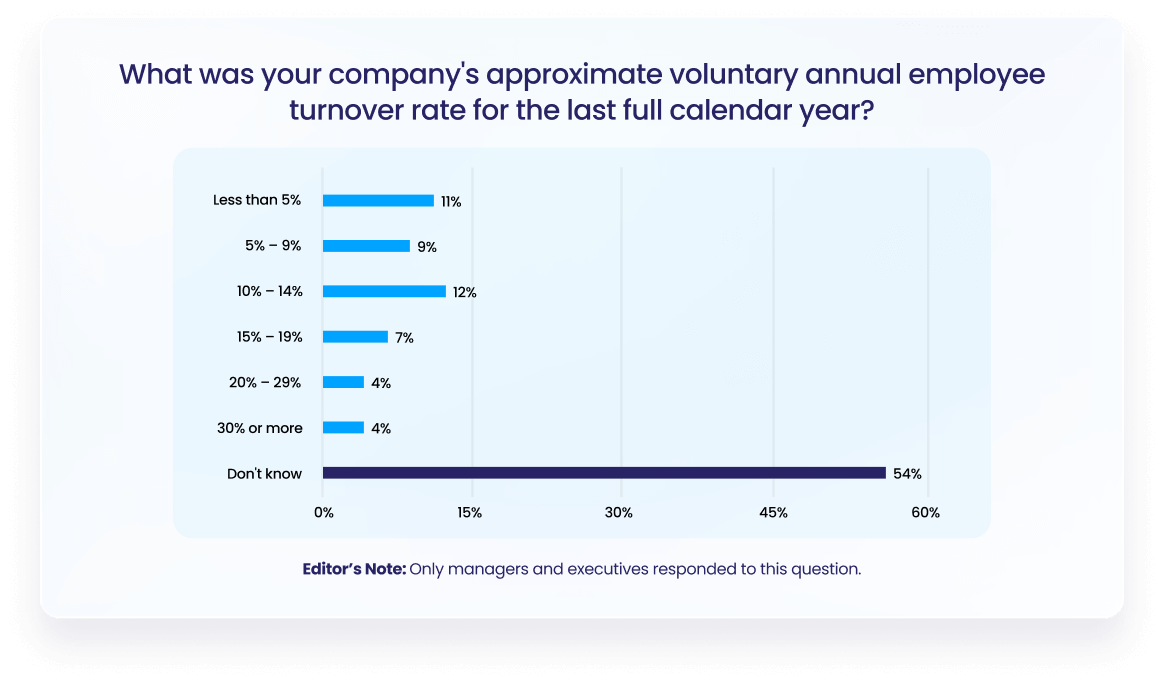
High voluntary turnover is often a lagging indicator of low engagement. Concerningly, 54% of managers and executives don’t know their organization’s voluntary turnover rates.
This blind spot is particularly troubling at the executive level. If executives are unaware if there’s a problem to begin with, they can’t intervene. This inaction likely negatively impacts work culture.
As stated earlier, change fatigue is a top concern in today’s organizations. This change fatigue could be a direct result of high voluntary turnover, which can also lead to greater work stress as fewer employees are forced to do more work per person.
The Turnover-Engagement Link
Forty-six percent of those who say their organization has a strong eNPS (25+) say their voluntary turnover rate is under 10% compared to just 33% of those with a weaker eNPS (-1 or worse).
Furthermore, culture leaders are simply more informed. None of those with stronger eNPS scores responded “don’t know” to the rate of voluntary turnover in their organization, compared to 40% of those with weaker scores. This suggests that high-performing cultures are built on data transparency.
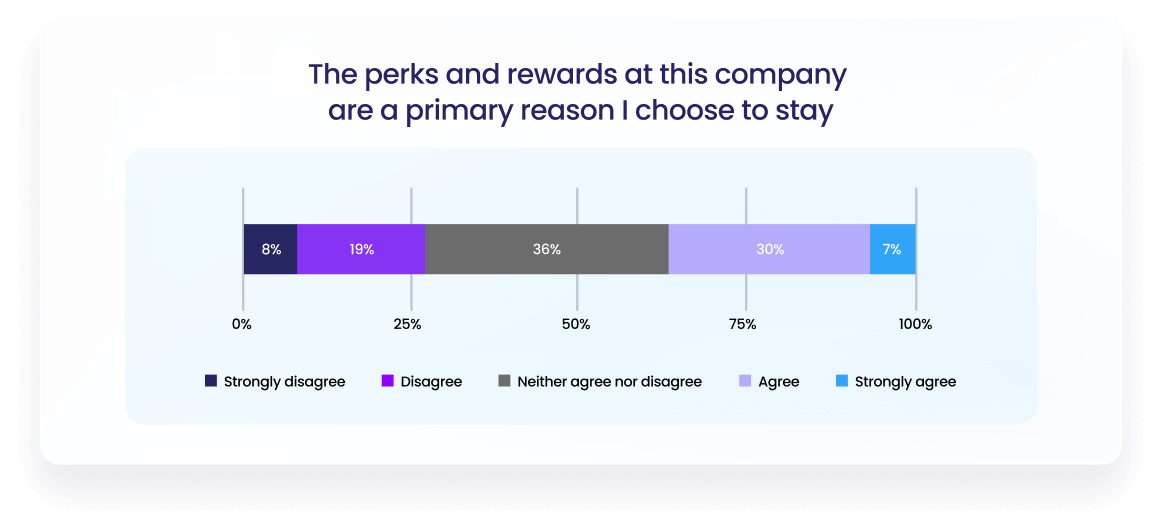
Perks and rewards have their own part to play. Two-fifths of respondents say that perks and rewards are a primary reason they choose to stay at their current company. Despite the importance of rewards, there’s no obvious annual budget for non-salary employees. In fact, about two-fifths either don’t know their budget or don’t have one.
The “Transactional” Employee
Respondents who say perks and rewards are a primary reason to stay in their current positions seem significantly more likely to place a premium on tangible returns.
This data suggests that while culture is the “sticky” factor for most, a robust rewards and perks strategy is the necessary anchor for this specific segment of the workforce.
.png)
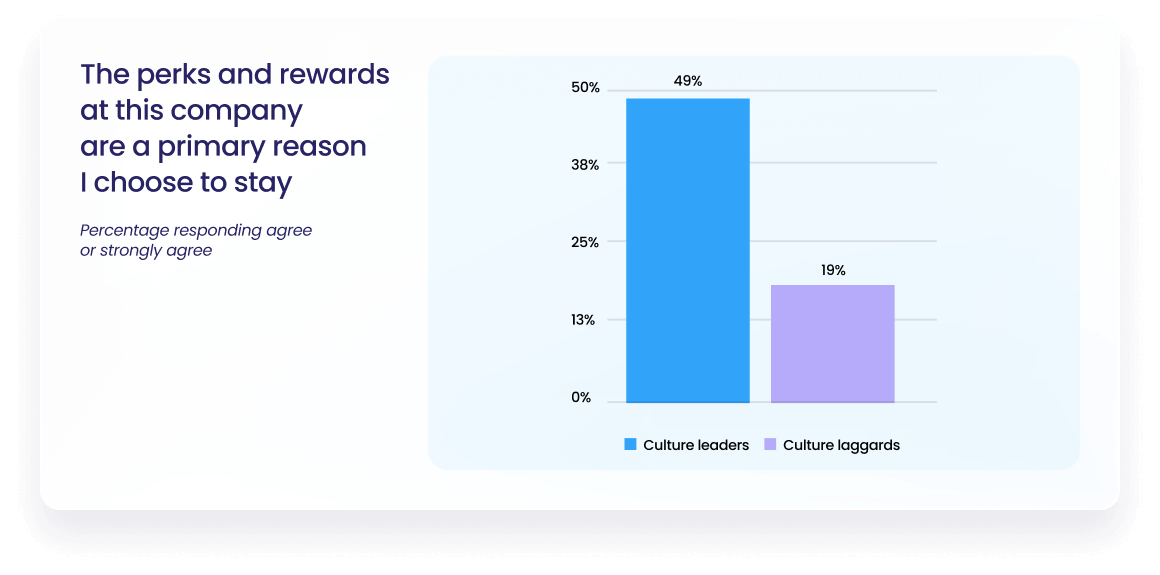
Nearly half (49%) of employees in culture leader organizations say the perks and rewards are a primary reason they stay compared to just 19% of those in culture laggard organizations.
This stark difference suggests that in high-performing cultures, rewards are not seen as separate “add-ons” but are integrated into a holistic value proposition that employees genuinely prize and are part and parcel of a positive corporate culture.
A chi-square test of independence shows that employees from culture leader organizations are significantly more likely than the employees in laggard organizations to say the perks and rewards are a primary reason they choose to stay.
This runs contrary to the conventional wisdom that organizations are either transactional or relational. In reality, relational cultures may also have transactional elements that appeal to many employees.
.png)
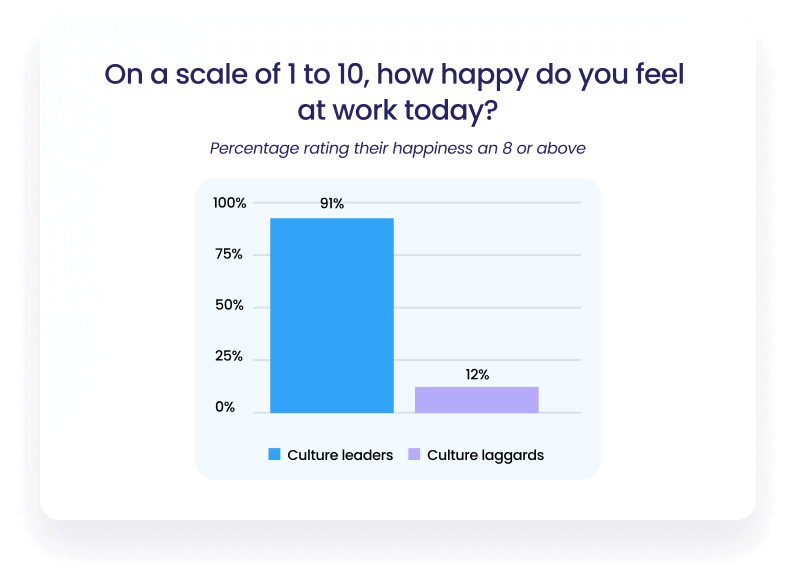
Employee happiness is often related to work-life balance, relationships with their teams, and rewards and recognition. When asked about how happy they feel at work, employees at culture leader organizations are nearly eight times more likely than those at culture laggard organizations to rate their happiness as an 8 or above on a 10-point scale (1 being extremely unhappy, and 10 being perfectly happy).

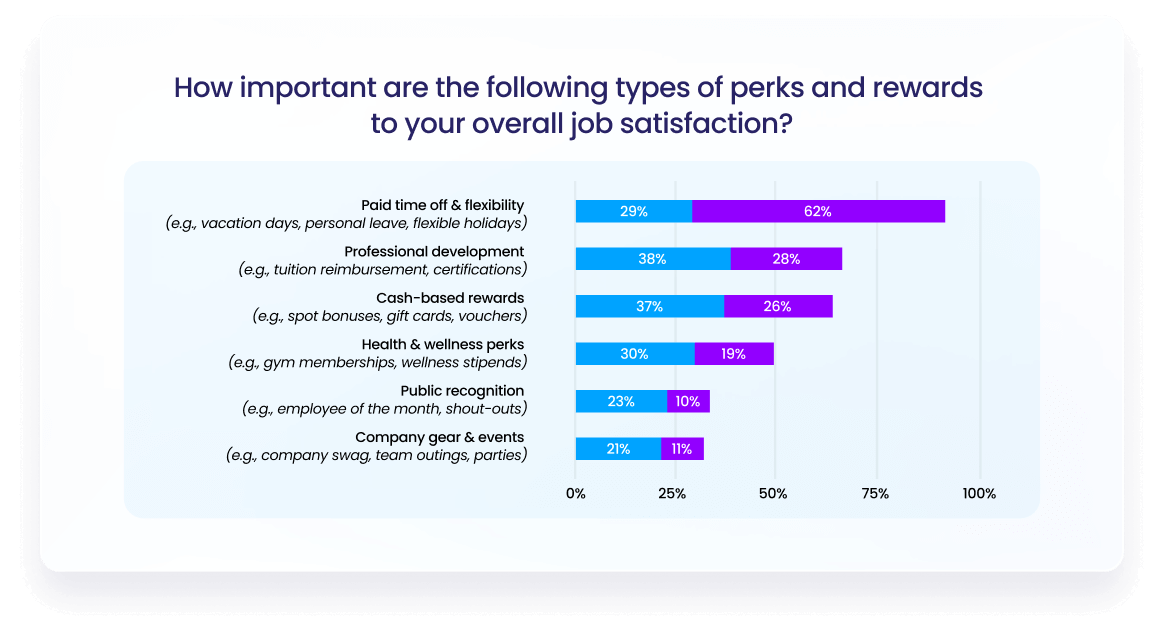
So, what perks and rewards are most important to overall job satisfaction? Paid time off and flexibility is by far the top response, with 91% citing it as very important or essential. This finding emphasizes the positive impact of work-life balance on culture mentioned earlier.
Professional development (66%) and cash-based rewards (65%) are also very important or essential to a sizeable proportion of respondents. Development opportunities help keep talent engaged, especially in environments where upward mobility is limited. Cash-based rewards, meanwhile, offer a tangible way to show employees they are appreciated. If personalized, these rewards represent a small investment that yields significant returns for the overall company culture, especially in difficult economic times.
Based on our research, below are a couple of suggestions:
Check to see if your organization is missing an opportunity with perks and rewards.
Most culture leader organizations seem to view perks and rewards as being a powerful retention tool.
Use total rewards statements as a retention tool.
Ensure employees fully understand the value of their entire package (including insurance, matching, and wellness access). This counters external offers by illustrating the true value of their existing role.
Don’t assume you know what perks employees care about.
HR’s sense of what a good perk is may differ from what employees actually care about. Use surveys to identify the specific rewards your workforce cares about and prioritize your budget based on research, not opinion.
Organizations need to go from just saying workplace connection and culture are priorities to actually taking meaningful steps for the greater good of the organization. Based on the findings from our research, below are some suggestions for organizations that wish to improve workplace culture and connection.
Thirty-eight percent of employees rarely or never receive meaningful recognition from their direct manager, and peers currently recognize one another more often than managers. Organizations benefit from tools that make recognition easy, visible, and woven into daily workflows, so appreciation becomes natural and consistent. When recognition happens publicly and often, employees feel valued. This reinforces engagement, increases discretionary effort and improves employee productivity and performance (as reported by 9 in 10 respondents).
Trust in leadership is fragile, with 47% of respondents reporting moderate to low trust. While CEOs are often visible, CFOs are seen as the least likely to take an active interest in culture. In culture-leading organizations, C-suite leaders are up to five times more likely to show strong involvement. Consistent, visible leadership support is essential for culture improvement.
A lack of clear communication is the top culture challenge. Poor communication creates confusion and frustration. Organizations benefit from simple and reliable ways for employees to share feedback, stay informed, and understand decisions. Regular pulse surveys and open communication channels help employees feel heard while giving leaders actionable insights to improve clarity and transparency.
Connection within teams is strong, with 86% feeling connected to their team and 58% believing they have enough opportunities to build relationships across teams. Cross-functional bonding reduces silos and strengthens organizational belonging. Employers can support this by promoting shared digital spaces and social interactions that bring distributed or hybrid teams together.
Most organizations collect engagement data, with 66% using employee surveys, but interactive relationship-building tools are underused. Only 32% use coaching programs, 27% use ERGs, and 18% use culture or engagement consultants. Employees benefit from platforms that provide spaces for connection, peer support, celebrations, and collaborative interactions, helping transform data into meaningful cultural action.
Fifty-nine percent of managers and executives do not know their eNPS, and 7% do not track it at all. Engagement insight tools that combine surveys, analytics, and recognition behavior help leaders understand how employees feel and where support is needed. Real-time visibility enables targeted action that improves morale, trust, and retention.
Fifty-four percent of managers and executives do not know their organization’s turnover rate. This is concerning because turnover directly affects morale and stability. In organizations with strong eNPS scores, none selected “don’t know” about turnover, showing that culture strength is linked to leaders consistently understanding and monitoring core talent metrics.
Managers significantly influence culture, with 31% citing managers as the top cultural factor. Culture leaders report stronger manager relationships, with 77% feeling connected compared to 31% of laggards. Training managers in recognition habits, communication, trust-building, and inclusive leadership directly strengthens connection and the overall employee experience.
Employees say enjoying their team (47%), enjoying daily work (42%), and feeling valued by colleagues (39%) are the biggest contributors to a positive work experience. These matter more than having a “best friend at work.” Organizations should strengthen team dynamics, collaboration, and positive daily interactions to enhance culture.
Perks and rewards play a major role in retention. Thirty-seven percent say perks are their primary reason for staying. Culture leaders are more than twice as likely to say this (49% vs. 19% of laggards). Paid time off and flexibility are essential to 91% of employees. Professional development (66%) and cash-based rewards (65%) are also highly valued. Organizations should choose rewards based on employee preferences to strengthen satisfaction and retention.