Employee recognition still gets treated like a nice-to-have in budget conversations, even though it moves the exact numbers executives already track. When recognition is frequent, values-based, and easy to measure, it shows up directly in retention, engagement scores, and manager effectiveness, not just in employee sentiment. This post gives HR leaders the actual numbers to build the business case, not just the feel-good argument.
Ask any HR leader why recognition never gets fully funded, and you'll hear some version of the same answer. It sounds like a nice thing to have, not a business requirement. Compare that to a new HRIS or an ATS overhaul, and recognition loses every time, because those systems solve a problem the CFO can already picture.
That's a culture problem masquerading as a budget problem. Recognition doesn't lose because it doesn't work. It loses because HR usually walks into the room with a values argument instead of a retention argument, and executives fund retention.
Here's the reframe. Recognition is infrastructure for connection, the same way your HRIS is infrastructure for payroll. Skip it, and the cost doesn't disappear. It shows up later as turnover, disengagement, and a workforce that quietly checks out.
Executives don't need to be convinced that recognition feels good. They need the retention math laid out plainly.
Suppose your organization has 1,000 employees and a 20% annual turnover rate. Replacing an employee typically costs between half and two times their salary once you count recruiting, onboarding, and lost productivity. Even a modest reduction in turnover, in the 20 to 40% range that companies using consistent recognition programs typically see, pays for a recognition platform many times over in a single year.
That's the number to lead with, not "employees will feel more appreciated." A 20 to 40% improvement in retention, applied to your current turnover cost, funds this program for the next three years.
Three stats worth memorizing for that conversation:
The psychology behind this isn't complicated. When recognition is public, frequent, and tied to a specific value rather than generic praise, it becomes self-reinforcing. One person gets recognized for solving a hard problem, a peer sees it, and the behavior spreads. Motivosity customers see this play out as an 18x increase in recognitions per employee compared to legacy, manager-only approaches.
Compare that to what most organizations are actually running. Recognition that depends entirely on a manager remembering to say something. No visibility outside a small team. No connection between the recognition and the company's stated values. Recognition without connection is transactional, and a transaction doesn't move an engagement score.
The clearest before-and-after example is Old National Bank, a 5,000-employee financial services company that had recognition, milestones, and social engagement scattered across four disconnected platforms. Consolidating into one system got 85% of employees logged in within the first month, generated more than 12,000 recognition moments, and gave the admin team back roughly a full workday per week.
"My manager cares about my well-being" became one of the company's highest-scoring engagement indicators after launch.
Step 1. Start with your current turnover cost, not your current recognition budget. Pull the number finance already uses for cost-per-hire and multiply it by your annual voluntary turnover. That's the number the room already trusts.
Step 2. Attach a conservative retention improvement, in the 20% range, to that cost. You don't need to promise the high end of the benchmark to make the math work.
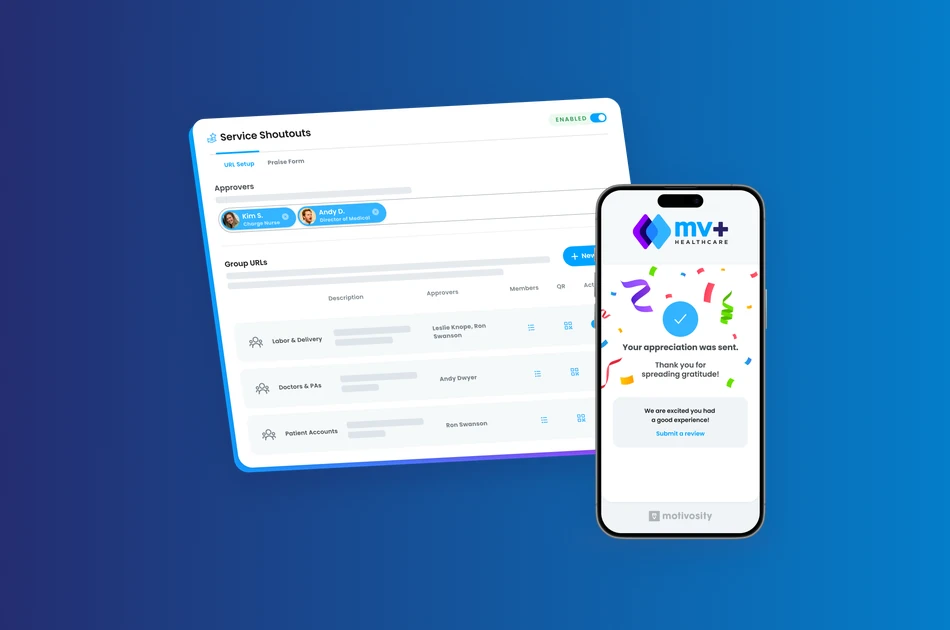
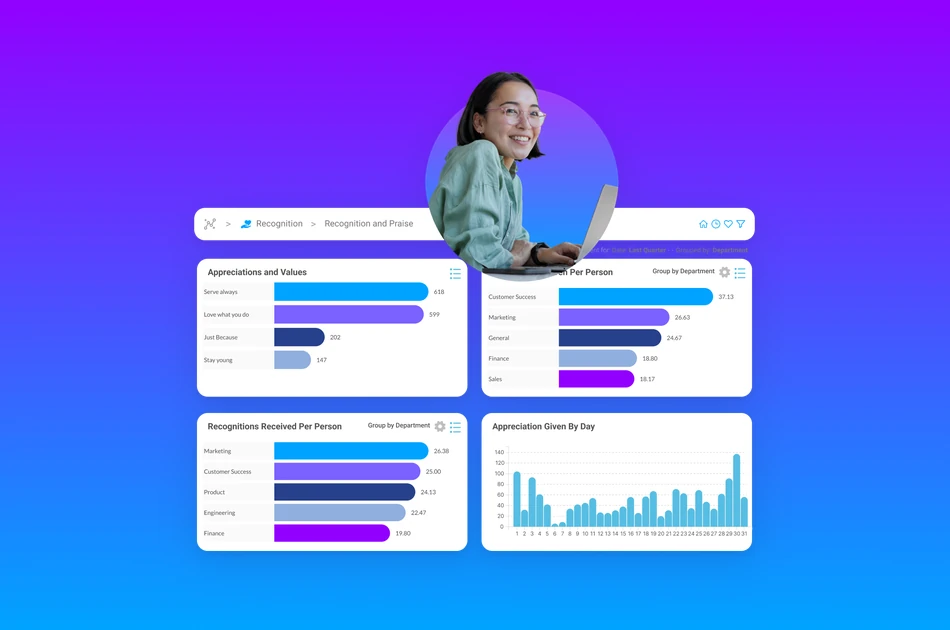
Step 3. Add the time-savings line. HR administrators typically reclaim 4 to 10 hours a week when milestone tracking, nominations, and reward fulfillment get automated instead of managed by hand, using tools like Reporting and Dashboards.
Step 4. Bring one proof point that mirrors your industry or company size. Executives trust a comparable example more than an industry average.
Let's say your organization has 800 employees, an average fully-loaded salary of $65,000, and a 22% annual voluntary turnover rate. That's 176 departures a year. At a conservative 75% of salary per replacement, turnover is already costing roughly $8.6 million annually.
Now apply a 20% retention improvement, the low end of the recognition benchmark range. That's about 35 fewer departures a year, worth roughly $1.7 million in avoided replacement cost. Compare that to what a recognition platform costs, typically $60 to $240 per employee per year, and the math isn't close. Even at the high end of that range, you're looking at a payback measured in months, not years.
Bring this exact structure into the room. Executives don't argue with their own turnover number. They argue with vague promises about culture.
The retention math gets you in the door. The follow-up questions are where deals stall, so it helps to have the answers ready before you're asked.
"How do we know this isn't just another tool nobody uses?" Point to adoption data, not intentions. Companies running Motivosity see an average 96% employee participation rate, well above the industry norm for HR tools that require a login and a habit change.
"What's our actual financial exposure with rewards?" This is a fair question, and it deserves a real answer. Look for zero-markup redemption and full visibility into outstanding reward liability, so finance can see exactly what's allocated, spent, and owed at any point, not a black box that surfaces during an audit.
"Can we start small and prove it before we scale?" Yes, and you should. A department-level or single-location pilot, run for one full quarter, gives you a live eNPS and participation baseline before you take the full-budget ask to the executive team.
Once the program is funded, the metrics that matter to the next budget conversation are the same ones you used to build the case in the first place:
Track these from day one. The second budget conversation is always easier than the first, and it's a lot easier when you're the one who already has the receipts.
The future of employee engagement is people first. Be the company that gets it right.