
Employee burnout is at an all-time high, with the majority of U.S. workers reporting stress, exhaustion, and disengagement at work. Burnout—defined by emotional exhaustion, cynicism, and reduced performance—is driven by poor management, lack of recognition, heavy workloads, and weak workplace culture. Organizations that prioritize employee recognition, mental health support, and strong leadership development can significantly reduce burnout, improve engagement, and prevent costly turnover. Platforms like Motivosity help companies proactively combat burnout by strengthening appreciation, connection, and culture at scale.
Want to know the worst kept secret about employees right now? People everywhere, including many working for your company, are experiencing employee burnout.
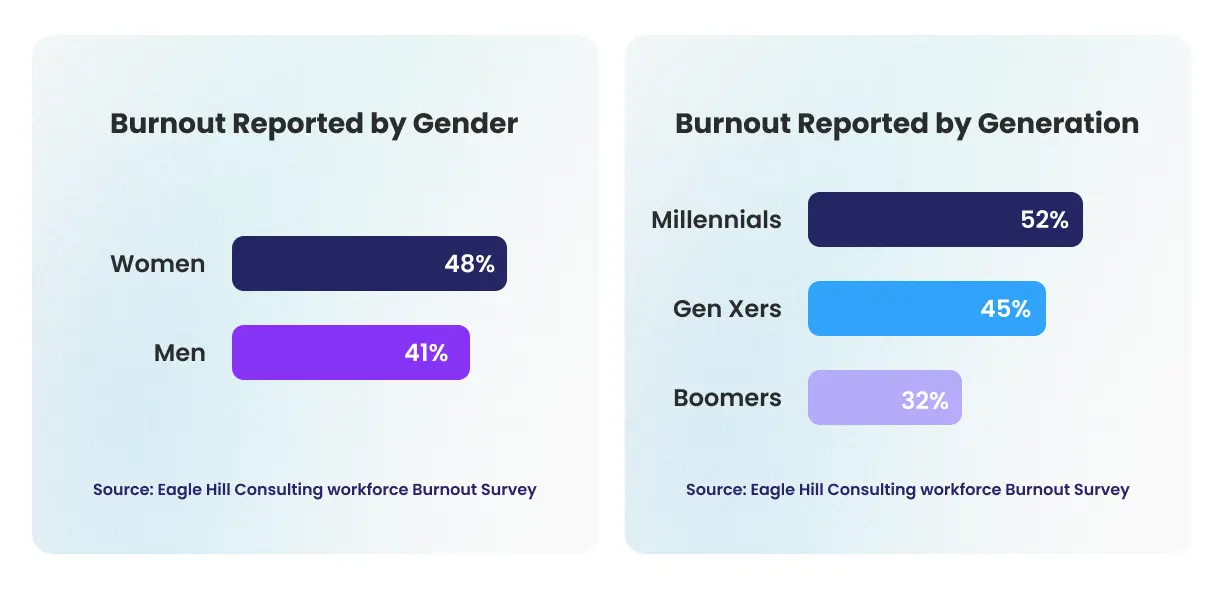
A 2020 survey from "Mental Health America" determined that 76% of U.S. workers have experienced burnout at work." This isn't a problem that's limited by gender or generation. According to an Eagle Hill study conducted in 2023, 48% of women reported feeling burnt out and 41% of men did as well. And though Millennials report being the most burnt out generation (52%), Gen X (45%) and Boomers (32%) aren't immune either.
The data indicates employee stress is up, mental health is abysmal and poorly equipped managers are a real thing - all combining for team members that are unhappy and disengaged. Not surprisingly, the eventual result is employee turnover...an expensive (and sad) problem for businesses. And a lame outcome for the employees themselves.
Ready for some help solving this massive issue? We're going to give you everything you need about addressing employees stress, how to prevent burnout and creating a positive work environment where your team can slay. (If you haven't heard the term "slay" yet, expect to hear it soon from your Gen Z hires!) This content will walk you through what employee burnout means, what causes it, the signs to watch for and how to help employees with burnout. When we're done with you, you're going to be able to solve this problem once and for all!
As we get started, let's make sure you understand some good news on the topic of employee burnout - literally everyone wants to solve this problem. No one is excited that worker burnout is such a prevalent reality.
Of course employees aren't happy about their heavy workload and lack of work life balance. Managers realize that long hours, mental exhaustion and workplace stress aren't helping. HR teams aren't thrilled that many employees are on the verge of quitting. And most CEOs want happy, engaged A-players - not a ragged army that's bitter and frustrated.
Everyone has an incentive to do better here. So let's get started and take some steps towards improving employee engagement by reducing employee burnout.
There are a number of definitions around employee burnout, and most portray very similar themes. We've gathered a few authoritative sources and their perspectives on employee burnout. We'll start with The World Health Organization since it has become one of the most commonly used definitions.
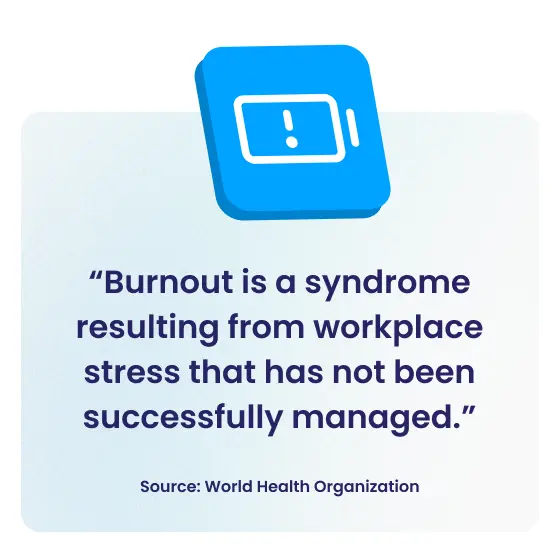
'Burnout is a syndrome resulting from workplace stress that has not been successfully managed. It’s characterized by three dimensions: feelings of energy depletion or exhaustion, increased mental distance from one’s job or feelings of negativism or cynicism related to one’s job, and reduced professional efficacy.' -World Health Organization
'Job burnout is a type of stress linked to work. It includes being worn out physically or emotionally. Job burnout also may involve feeling useless, powerless and empty.' -The Mayo Clinic
'Employment burnout...is a state where you lose all motivation or incentive, leading to feelings of depression or stress. This can be a very uncomfortable state that can affect employee productivity, retention, and well-being.' -VeryWellMind
The persistent theme here? When people are overwhelmed and under supported at work, their mental health suffers, they experience emotional exhaustion, and their performance decreases.
Worse case scenario - they quit performing all together and become a drain on the workplace culture. There are varying levels or degrees of burnout, but left unchecked it will almost certain lead to bigger problems across the organization. In the end, you are going to wish you had found ways to combat burnout rather than letting it run its course. But what causes burnout in the first place?
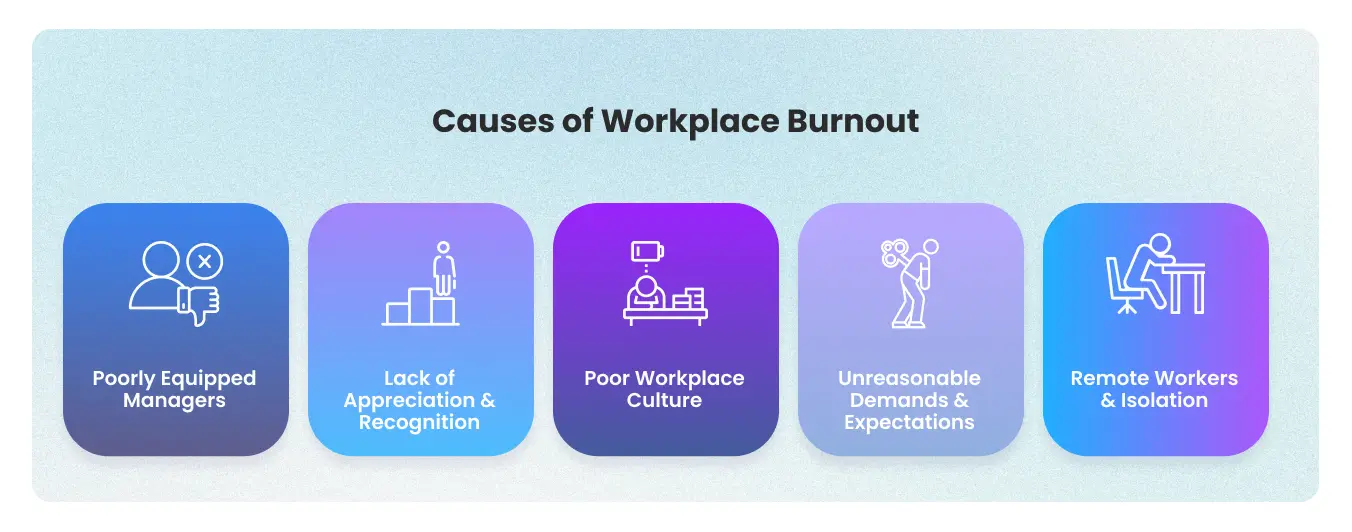
What causes burnout for one person might not be an issue for another. We each have different backgrounds, values and opinions that make some situations easier, while others become unbearable for us. Though no one should expect work to be perfect, here are some of the most common issues that cause burnout for employees today:
Nothing can cause employees to disengage and resent their job faster than a bad manager. Gallup provides some powerful insights on this and states that 70% of the variance in employee engagement scores is based on a person's manager.
Gallup further proves the point: 'Bad managers cost businesses billions of dollars each year, and having too many of them can bring down a company. The only defense against this problem is a good offense, because when companies get these decisions wrong, nothing fixes it.'
A bad management style is the fastest ticket to burnt out and unhappy employees. It can completely ruin work life balance for an otherwise great contributor. Hiring leaders that don't develop employees, letting them micromanage, and ignoring best practices around management training is a sure path to a frustrated employee. If you want to prevent employee burnout and therefore reduce employee turnover, focus on your people leaders.
Everyone wants to feel like their work matters. They want to be recognized for their effort and contributions. In a survey conducted by One Poll and Motivosity, we discovered that 75% of employees felt their mental health would improve if they were recognized at work more often.
Recognition can look different for various companies, teams and individuals, but if you don't celebrate your people - they will burn out. If your attitude is: 'your paycheck is your reward' plan to eventually see your employees running out the door.
Don't believe me? The team at SHRM wrote, 'Generation Z and Millennial employees are much more likely to feel dissatisfied at work and seek better experiences elsewhere, a national study of adults ages 18 to 38 finds. Close to half (43 percent) of Millennials and 78 percent of the youngest workers surveyed—Generation Z—plan to leave their job within the next two years.' Their data further proved this point, as SHRM claims:
Deloitte data supports what SHRM has to say. In their recent Workplace Burnout Survey, "lack of support or recognition from leadership" was the top driver of burnout and was cited by 31% of participants. That's not good.
A bad culture is taxing on the emotional wellbeing of everyone. What makes a bad culture? Unfair treatment, rude coworkers, an unsafe work environment, bad leaders (see the manager section above), being overworked, poor communication skills, lack of values, misalignment across departments, nepotism, non-flexible work schedules, etc. All of these examples impact culture and if it's not managed intentionally, the outcome will be a culture of burnout.
Some may experience burnout simply because there is too much work for them to do. If their coworkers have been laid off, they may feel blatant pressure from their employer so they can keep their own job. Maybe they are expected to take on the workloads of their former coworkers. Their manager could be unaware of the load they're carrying. Perhaps they're just the type of employee that can't say "no".
According to Eagle Hill, "When asked about the causes of their burnout, 51 percent of workers say their workload is the biggest driver, up from 48 percent in August 2022." When workloads go unchecked, burnout can be around the corner.
Remote workers commonly experience burnout simply because they are isolated and don't get some of the "in person" benefits. If a solid communication strategy isn't in place, they may miss important information or interactions that happen between in-office coworkers. They could feel increased pressure to perform so that no one questions their contribution or integrity. Remote work can be hard, as indicated by the fact that 69% of WFH employees cited feeling burnt out.
Unfortunately, that's not an exhaustive list of what can ruin work for your people. Here are a few more: unclear expectations, bad team members, mental health issues, work related stress, the impact of personal lives, absence of career paths or career advancement, lack of flexible scheduling, the evolving technological landscape, and too much autonomy. Any of these can exacerbate employee stress.
Not sure if these items are causing problems across your organization? Well, there are signs of burnout and we're going to make sure you know exactly what to look for.
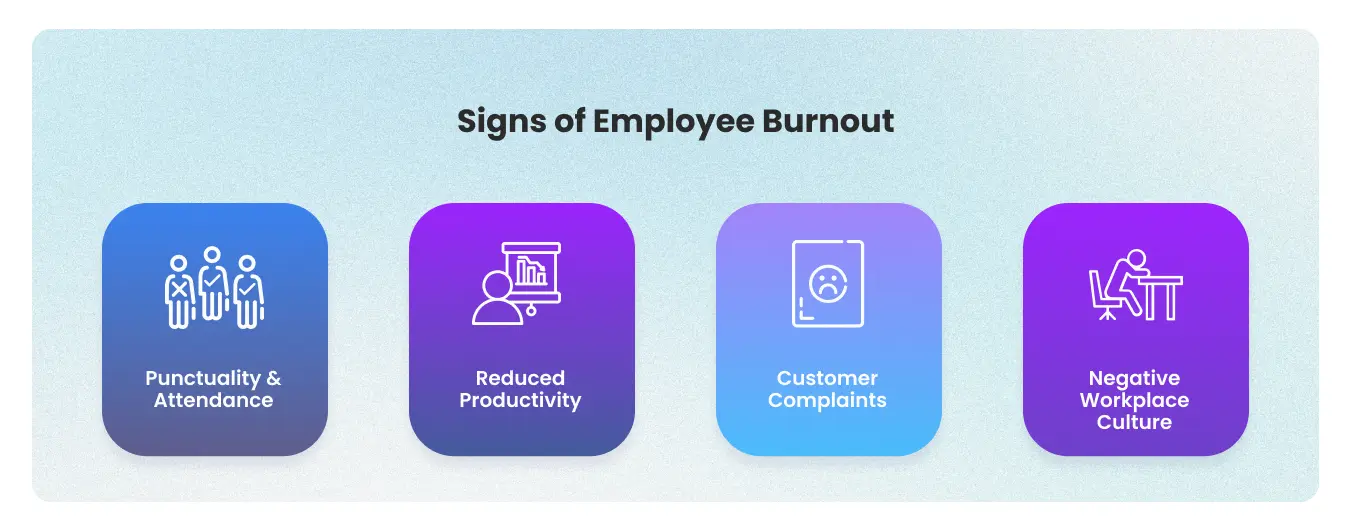
Because we're all unique, expect the 'symptoms' of employee burnout to be unique as well. It may look different for every team member and will certainly look different the longer it's left unaddressed. But one foolproof trick - be aware of changes in behavior. If positive behaviors start to disappear and less ideal behaviors creep in, it's likely time to start addressing burnout. Here are some common signs of burnout that may be noticeable to HR or people leaders that are paying attention:
It's normal to be late or miss work once in a while. Maybe they slept in or traffic was bad. But if punctuality and attendance becomes a consistent issue, it may be a red flag for employee burnout. If your company has certain expectations around working hours, or someone is frequently late to that morning meeting, you might want to check in and see how they're doing.
Again, change in behavior is helpful here...some people are just always running late. But when a normally punctual employee starts rolling in late day after day, see how you can help.
Burnout and job stress have a direct impact on mental health and can impact an otherwise healthy lifestyle. The mental and physical stress associated with lack of work life balance can cause many employees to avoid going to work all together. If you start getting frequent "I'm sick" calls in the morning from employees that have been healthy, here's your sign.
Zero surprise that when you're exhausted and stressed, it's difficult to perform your best at work. That could look like missed deadlines, lower quality deliverables or more mistakes. This can be true in literally any industry - burnout can impact the productivity of lawyers, doctors, factory workers and grocery store attendants. If you want improved productivity across the organization, make sure you're helping people be their best. (Keep reading! We promise, the ideas for encouraging employees to resolve their burnout are coming!)
When burnout is a factor, customers will eventually feel the impact. If you're seeing an increase in customer complaints then it's a clear sign that you need to start addressing employee stress and find ways to boost employee engagement. You know the old saying: 'Where there's smoke, there's fire.' And you don't want fire anywhere near your customers!
Even a single burnout team member can impact workplace culture, but if it's a broader issue then everyone will feel it. When morale starts to drop, it will likely lead to further burnout in the organization. Bad culture can create a negative spiral: it leads to burnout for one who then creates it for others. Burnout is contagious.
We've shared a lot of examples that you may see in your team members regarding burnout. But what about you? If you're having difficulty concentrating, are sleeping less, feel uninspired, are more irritable, or are struggling with your mental health, maybe you're experiencing your own form of burnout.
Don't worry - we have some ideas about how you can cure and prevent employee burnout. These ideas are great for companies working to prioritize their team members and they'll work for you personally as well.
Based on the statistics, you definitely have someone in your team or company that isn't able to bring their A-game right now. So what's the cure and how do make the office engaging again? And then, what do you do to prevent it from being an issue in the future? You can make a difference, even if you're a small HR team, manager or an executive. The main concept is to promote self care. Here are some specific examples of how to do that:
Mental Health Days: Providing mental health days can give people a much needed rest from their problems at work. It gives them a moment to slow down and focus on stress management. This is simply a day away from the office...away from meetings, emails and deadlines where you can encourage employees to recover. At Motivosity we think of mental health days within our corporate wellness programs. We want people to be sharp and have some time to think about their own lives, so we encourage employees to take one mental health day each quarter. Our only ask? Disconnect and then share what you experienced with your manager.
Mental Health Counseling: Many corporate wellness programs are key to reducing burnout. Some employees need mental health counseling and time with a mental health professional can give them clarity around their situation at work. Make sure this is part of your health benefits package. Encourage employees to take time away from work for their visits if needed.
Employee Gym Memberships: Exercise helps reduce stress, so encouraging employees to be physically active can lead to great results. Some companies invest in exercise equipment that can be used on site. Others provide employee gym memberships or reimburse gym expenses. Helping employees obtain access to exercise equipment is a great strategy.
Group Health Challenges: If you can get a group to focus on wellness together together, it can improve health, strengthen relationships and reduce risk of burnout. Encourage people to take walks around your building together. Have a group that smokes? Organize tobacco cessation programs for them. Put together group healthy eating challenges. Research consistently shows that healthy employees are better employees, and a group effort can provide the support needed to make real changes.
We mentioned earlier how managers are crucial for employee satisfaction and when it comes to solving employee burnout. Invest in efforts that develop employees. Allowing employees to focus on self care is another big step. But the best managers ensure employees feel seen and heard. One of the most powerful ways to do that? Gratitude, appreciation, recognition and celebration. You can expect happier team members and improved productivity when you consistently thank people for their work and tell them they're doing a great job. It will reduce employee stress and create a positive work environment for your team members.
Your team is the most crucial part of your business. Without them, the product doesn't get developed. No one learns your company exists. Services don't get sold. Your customers are ignored . Money doesn't get collected. If you don't have employees, eventually you won't have a business. So take employee burnout seriously. The first step? Make sure they feel seen and recognized for their work. When they feel like their work matters and is being celebrated, it will quickly eliminate (and prevent) burnout for your people!
Interested in how Motivosity's recognition and rewards can address burnout for your company? Learn more now!