The data on employee engagement in 2025 tells a clear story: engagement is declining, the cost of disengagement is enormous, and the companies that get this right have a real competitive advantage. This post breaks down the most important engagement statistics across purpose, autonomy, recognition, leadership, and remote work — and what they mean for building a workforce that actually wants to show up.
Key Takeaways:
“Healthy and engaged employees, in concert with a strong workplace culture, are the secret sauce for business success.” — Naz Beheshti
There's no doubt about it, employee engagement is intrinsically linked with business success in the modern world. Highly engaged and emotionally invested team members are invariably more productive, committed, and loyal.
Therefore, it's important not only to find ways to engage employees but also to track and monitor your company's engagement statistics, comparing them against global trends.
This guide aims to support you in that effort. Below, we'll explore some of the most intriguing and up-to-date employee engagement statistics, examining what these numbers really mean for your company and the wider working world.
Employee engagement isn’t just relevant in 2025; it's arguably more important than ever before.
The reason is clear: today's professionals are more discerning and reflective than past generations. With their increasingly diverse needs and abundant career options, employers must now work harder to foster engagement. This requires providing compelling reasons, incentives, and encouragement to align teams with the company's mission and objectives.
What's more, countless employee engagement statistics show that there is a direct correlation between engagement and some of the most important business KPIs, including profitability, productivity, employee retention, absenteeism, morale, and, ultimately, organizational success:
These are just a few of the many powerfully convincing statistics that demonstrate how engagement and emotional commitment contribute to business success. It's not something that business owners and leaders can overlook—for success, sustainability, and the most positive business outcomes for your brand...You need to prioritize employee engagement.
Next, let's delve into some of the most meaningful and intriguing employee engagement statistics of 2025, with a closer look at how companies with engaged employees tend to outperform those with disengaged employees.
Gallup's Global Workplace Report reveals that just 31% of professionals in the U.S. are actively engaged at work.
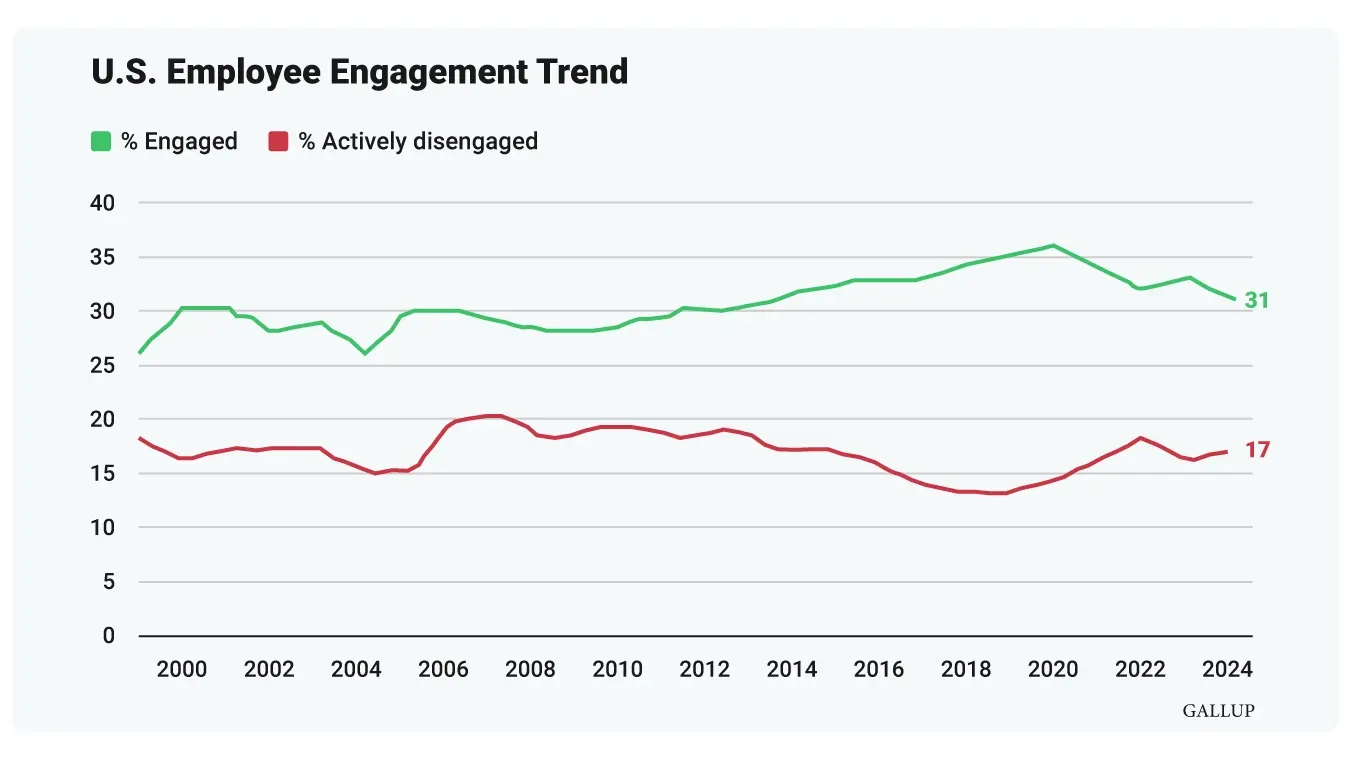
You have to go all the way back to 2014 to see employee engagement rates so low, as recent years have seen more encouraging figures, like 33% in 2023 and a high of 36% in 2020.
The latest statistics also show that 17% of the U.S. workforce is comprised of actively disengaged employees. Again, this figure mirrors that of 2014.
What can we learn from this?
These statistics suggest that despite a growing focus on employee engagement — and significant investments in employee wellness programs, total rewards models, and other ways to improve employee engagement — a sizable portion of those strategies are failing to get positive results.
In other words, there remains a clear gap between recognizing the importance of employee engagement and effectively improving it.
Less than 1 in 3 employees are engaged, with various elements of the workplace negatively impacting their motivation, morale, and commitment. Clearly, while there are some highly successful businesses out there, many still have much work ahead of them to improve employee engagement among their workforce.
On a positive note, this also represents a serious opportunity for certain companies to gain a competitive edge. If you can make your firm one of the few to have a truly actively engaged workforce, that might make all the difference in profits, production, and achieving your goals, while rivals continue to lag.
This statistic comes from Trade Press Services, which reports that the vast majority of employees feel most motivated when internal communications are clear and efficient. In other words, team members like to be in the loop regarding company news and appreciate clear explanations of their goals, duties, and roles.
This makes a lot of sense.
Imagine two employees in similar positions at separate but similar companies. One is regularly kept informed by HR leaders and managers about what's happening in the company, what they're working towards, the latest projects, and key pieces of company news, etc. The other is kept in the dark, lacking information and insight, unclear about their role or responsibilities, and how they tie into the broader plans and goals of the company.
Naturally, the more informed individual will be far more likely to be engaged. They'll feel more valued and part of the team and better understand how and why their contributions matter.
Various additional statistics back this up. For example, companies with strong internal communications see 47% higher returns to stakeholders, thanks, in no small part, to improvements in employee morale, engagement, and productivity. In addition, 50% of employees agree that a lack of transparency holds their companies back.
It's clear to see that if you want to create highly engaged business units, communication is key.
Ultimately, every business exists to make money, which is why it's so important to see the clear, undeniable link between high employee engagement and the most important metrics of business performance: profit and productivity.
Engaged employees significantly outperform disengaged ones, and, as stated earlier on, businesses with engaged workforces see an average of 21% higher profits.
This notable difference stems from the fact that highly engaged workers are far less likely to be distracted, lose interest, or put in less than their maximum effort. Instead, they're eager to give their all, play their part in the company's success, and actively help the business grow.
Meanwhile, disengaged employees cost businesses huge amounts each year, not just in terms of lost productivity, but also because of absenteeism. Disengaged workers are far more likely to take time off, with highly engaged employees achieving 78% less absenteeism.
So, not only does employee engagement inspire your employees to give more and work harder, but it also makes them more present, with fewer days of leave and more hours of hard work towards your company's goals.
To improve employee engagement, businesses first need to overcome a range of challenges in their way. Some of these challenges are growing larger and more significant by the day, particularly those related to employee well-being and job satisfaction:

Clearly, a lack of employee engagement is a heavy weight, holding businesses back from achieving their potential. However, business leaders need to find the right ways to engage their teams while also addressing issues like stress, burnout, micro-management, lack of support, and excess pressure on individual employees.
In the following sections, we'll look at four key areas of business, exploring how each one can improve or hinder employee engagement.
People want to feel that they have a purpose, that their work means something. Surveys show that those who have emotional commitment and purpose in their work are more than three times likelier to stay with their employers than those who don't.
Often, this level of commitment is also a sign of good company culture. The easier it is for employees to buy into and align with your culture and mission, the likelier they are to give their all for the cause.
Work-life balance is increasingly important to today's top talent, particularly those of younger generations. The more flexibility and freedom you can provide, the more employees feel valued and capable of balancing their professional and personal lives.
This applies to both on-site employees and remote employees, with stats to back it up: employees say they are 12% more likely to be satisfied with their work when they're granted freedom and autonomy, while a Harvard Business Review shows 59% think flexibility is more important than salary.
Recognition and rewards are also directly linked with job satisfaction. Individuals seek appreciation for their efforts and value a diverse range of appropriate incentives. In fact, over half of all employees think that their performance depends on the rewards/recognition they receive.
Furthermore, professional development opportunities also have a part to play. Many professionals want to see available career advancement opportunities, plus learning and development opportunities in their workplace, with 59% indicating that training directly improves their performance.
Leaders play a pivotal role in shaping employee engagement and influencing how employees feel, through methods like verbal recognition, constructive employee feedback, clear communication, and transparency.
Engaged teams tend to be those with strong but supportive leaders, who know how to make employees feel heard and valued. Many employees want to receive more feedback, too, with 58% desiring more frequent feedback and engagement surveys.
Today, a growing number of businesses rely on remote or hybrid workers operating from home and other locations. Engaging remote team members from a distance can be more challenging compared to on-site employees you can see and speak to face-to-face.
Arguably, the two most important factors here are flexibility and communication. Remote employees tend to desire more independence and autonomy than on-site workers, often preferring to be trusted to manage their time and tasks themselves, rather than feeling pressured to attend daily meetings or sign onto platforms at specific times, as though they were back in the office.
With appropriate levels of freedom, remote employees should find it easier to manage their work-life balance and enjoy a happier employee experience. At the same time, regular and clear communication will help them understand the work they do, how it ties into the company's culture and mission, and what's expected of them, which should also aid in supporting employee well-being.
So, what can you learn from these stats and how can you act upon them to build an engagement strategy that gets results, driving employee satisfaction, morale, and productivity for the future? Here are some key takeaways:
The statistics prove, beyond any doubt, that employee engagement is invaluable for business success. If you can get your employees highly engaged by building a positive company culture and pleasant employee experience, you'll soon reap the rewards in productivity, profitability, retention, and beyond. So, if it's not already, make employee engagement an integral aspect of your business strategy today.