The traditional workforce model is evolving fast — and blended workforces, which combine full-time employees with part-time, contract, and gig workers, are becoming a practical reality for companies looking to stay agile. The strategy comes with real advantages, but it also introduces new challenges around culture, connection, and engagement that most organizations aren't fully prepared for. Getting the people side right is what separates a blended workforce that thrives from one that fragments.
Key Takeaways:
Work is looking a lot different these days, and if you’ve read the news recently, you know that’s not changing anytime soon. People are clocking in differently, logging their hours differently, and spending a lot more time on freelance side gigs. The old-fashioned 9 to 5 isn’t necessarily going to be the future.
Blended workforces are positioned to address this problem in many ways, giving both businesses and their employees the freedom to grow and flow. But that doesn’t mean it’s easy to implement, or even the right strategy for every business. In fact, most of today’s companies lack the culture or mindset it takes to make the switch at all.
So what is a blended workforce, and how can you position your company to reap the benefits? Let’s take a closer look.
Blended workforces are companies that willingly combine in-house professionals with contractors and gig workers to accomplish their goals. These organizations typically have a mix of full-time, part-time, contract, and freelance employees working across various hours or multiple capacities. Some workers may physically come into the office, while others simply telecommute.
As you might imagine, this type of business model wasn’t really possible until a few decades ago. The advent of video, email, and instant messaging opened up a whole new world, allowing teams to hire experts in any capacity (and on any subject). Some blended workforces might look pretty uniform, with just a couple of contractors hired at a time. Others might be perfectly split down the middle, with 25% contractors, 25% full time, 25% part-time, and 25% temp.
An important note: blended workforces are not necessarily all remote. This is totally possible, but it doesn’t really meet the standard definition. Workforce blending is about retaining employees in different capacities, not about where they work. With that said, lots of blended workforces have remote or flex-scheduled teams.
Companies relying on blended workforce models are 40% mixed between full-time staff, part-time members, and freelance gig workers. New additions are chosen according to specific markers, namely the company’s future needs, current projects, and budgetary requirements.
Let’s look at it from a real-life scenario. If a company is planning to complete a one-off project involving a graphic designer, they might hire a temp worker or a freelancer to get the job done. If they expect to heavily use graphic design in the future, hiring a full-time or part-time employee might make more sense.
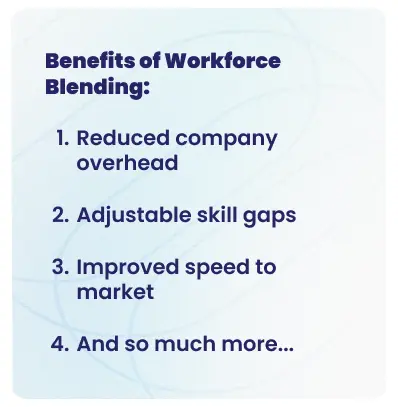
So what are the benefits of a blended workforce strategy?
Some people believe that workforce blending will one day make the difference between a business's success and failure. This is largely to do with the strategy’s most notable benefits, including:
Workforce blending is a complicated process that varies according to your industry and organizational goals. Though the specific details will vary according to your organization, we can give you a few steps to get started.
What skills or functions is your company lacking? Could gig work fill in the gaps, or will you need more long-term roles?
Equip your managers to lead in confidence with teams in any capacity.
Allow all workers, no matter their employment status, to provide feedback about their job and your processes. Listen to what they have to say, and transition accordingly.
More than anything, building a blending workforce takes time. If you’re willing to start slowly and steadily scale, you could build a long-lasting strategy that stands the test of time. Remember: it’s a marathon, not a sprint!
Of all the considerations that come from a blended workforce, few are quite as tricky as team engagement. From full-time staff to part-time gig workers, it can be hard to get blended teams to be passionate about their jobs, their goals, and connecting with each other. Blended workforces are as nontraditional as they come, which is why you need a nontraditional platform to help you succeed.
Enter Motivosity!
An award-winning engagement and recognition platform, our company has spent the better part of a decade building community, leadership, and a culture of connection for the world’s best businesses. We offer four unique platforms that can be customized to meet any need — including blended workforces. Yep, it’s just that easy!
Get in touch with a team member at (801) 758-7188 to talk about your packaging options. Interested in trying out a demo first? Glad you asked! Just send over a form at your earliest convenience, and we’ll get back to you as soon as we can. No matter what your workforce might look like, we’ve got the solutions that matter!