Healthcare doesn't have a recognition problem because leaders don't care. It has one because most recognition tools were built for people who sit at a desk all day, and healthcare teams don't work that way. When recognition actually reaches the floor, not just the front office, burnout drops and patient care gets better, because a caregiver who feels seen shows up differently for the next patient.
This isn't theory. Healthcare organizations using Motivosity have seen it directly: a hospital system where recognition became the most used platform in the building, a pediatric practice where recognition activity grew 30 times over, and teams where nearly every employee gets thanked regularly. Here's how recognition actually reduces burnout, and what it takes to build a program that reaches shift based, dispersed healthcare teams.
Key Takeaways
Ask any healthcare HR leader what keeps them up at night and burnout is near the top of the list, right alongside staffing. Those two problems are more connected than most recognition programs treat them.
Workforce surveys across the healthcare industry consistently point to the same pattern, caregivers doing some of the hardest, highest stakes work in any profession, often without ever hearing that it mattered. That is not just a morale issue. Feeling unseen while doing emotionally demanding work is one of the clearest paths to burnout there is.
Recognition will not fix a genuine staffing shortage on its own. But it does fix the part of burnout that comes from invisibility, and that part is bigger than most organizations assume. Employees who feel genuinely appreciated bring more resilience into a hard shift than employees who feel like a number on a schedule.
Most recognition software gets built for people who sit at a desk and check email all day. Healthcare does not work that way. Nurses, techs, and clinical staff are on the floor, between patients, on a rotating shift, often without a company laptop in sight.
A tool that assumes everyone is reachable at a desk will quietly exclude the exact people who need recognition the most, the frontline and deskless staff who make up most of a healthcare workforce. If you want the deeper version of this argument, I wrote about it directly in employee recognition for frontline and deskless healthcare workers.
A few things separate recognition that actually works in healthcare from recognition that looks good in a sales deck.
None of this replaces fixing pay or staffing ratios. It is the layer that makes the day to day experience of the work feel different while those bigger problems get solved.
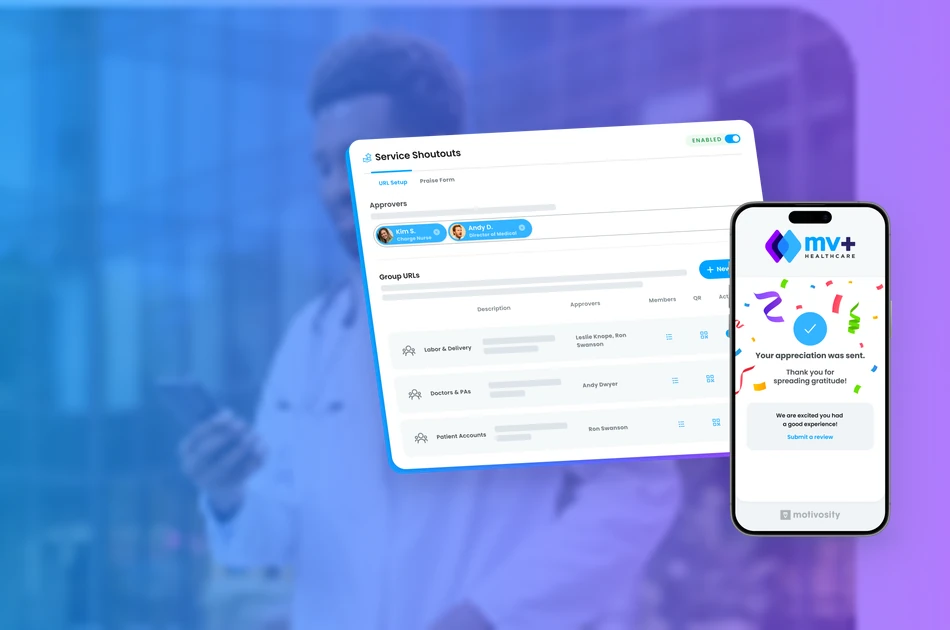
This is not a hypothetical. A hospital system with around 1,400 associates has called Motivosity its most used platform in the building, because, in their words, that is where their people are. A pediatric healthcare practice saw recognition activity grow roughly 30 times over after rolling out a program built for their team, with a large share of frontline physicians actively participating. Another healthcare organization reached 98% of employees receiving regular thanks, logging more than 15,000 appreciations in a single year.
None of that happens with a generic rewards catalog. It happens when recognition is woven into how a dispersed, always on shift team actually communicates, a theme I come back to often, including in these employee retention strategies for healthcare and the best recognition programs for hospital employees.
Patients feel the difference between a care team that feels supported and one that is running on empty, even when they cannot name why. A caregiver who feels valued shows up with more patience, more presence, and more of the bedside manner that actually defines a good patient experience.
That is the real case for treating recognition as a clinical quality issue, not just an HR nice to have. Staff experience and patient experience are not two separate metrics. They move together, which is also the throughline in these ideas for preventing nursing staff burnout.
The most common hesitation from healthcare IT and compliance teams is reasonable, will this touch protected health information. It will not. Recognition and culture platforms like Motivosity are built to run alongside clinical systems, not inside them. No PHI, no patient data, just people recognizing people. That is worth confirming directly with your security team before rollout, but it should not be the thing that stalls a program that could meaningfully reduce burnout.
Three practical steps for any healthcare HR or people leader looking at this today.
If you want to see what a recognition program built for the floor, not just the front office, looks like in practice, explore how Motivosity supports healthcare teams or take a closer look at Motivosity's employee recognition software.